To care for a wooden salad bowl, hand-wash it in warm water with a drop of mild dish soap right after use, then towel-dry it immediately — never let it soak, and never put it in the dishwasher. Re-oil it with food-grade mineral oil every 4–6 weeks, or whenever the wood looks pale and dry.
By Manvee Vaid, founder of TerraKlay · Updated August 2026
That is the whole routine. Everything below is the detail: how to wash without raising the grain, which oils are safe and which will ruin a bowl, how to lift a stain or a water ring, and what to do when a bowl starts to look tired. Our bowls are hand-carved from a single block of hardwood rather than turned on a lathe, which changes a few of the rules — we will say where.

How often: after every use with food. A bowl that only holds fruit or bread does not need washing each time — wipe it with a barely damp cloth and dry it at once.
Oiling is what people mean when they talk about seasoning a wooden bowl. It replaces the oil that washing and time draw out, stops the wood drying and cracking, and brings the color and grain back.
How often: every 4–6 weeks with regular use, and more often in a dry climate or through a winter of forced-air heat. The practical test is water. Put a few drops on the inside of the bowl: if they bead up, the finish is doing its job. If they soak straight in and darken the wood, it is time to oil.
How to do it:
A new bowl drinks more than an old one. For the first month, oil it once a week; after that, once a month is plenty.
| Oil | Safe for food use | What to know |
|---|---|---|
| Food-grade mineral oil (USP) | Yes | The standard, and what we recommend. It never goes rancid, carries no flavor and no allergens, and costs very little. It is the oil in our Wood Conditioning Kit. |
| Beeswax and mineral oil blend | Yes | Mineral oil with a wax topcoat. More water resistance and more sheen. Best applied over a base coat of plain oil rather than instead of one. |
| Walnut oil | Yes, with a caveat | It polymerizes into a harder finish, which some people prefer. But it is a tree nut — do not use it on a bowl you will serve from if you do not know your guests' allergies. |
| Fractionated coconut oil | Yes | Stays liquid and will not turn, unlike ordinary coconut oil. |
| Olive, vegetable, canola, sunflower | No | These are cooking oils. They oxidize and go rancid in the wood, leaving a sticky film and a stale smell that is very difficult to remove. This is the most common way a good bowl is ruined. |
| Tung and linseed finishing oils | Not for a bowl in use | Pure tung oil is food safe once fully cured, but the versions sold in hardware stores usually contain driers and solvents, and cure times run to weeks. Not worth the risk on a serving bowl. |
The bowl is thirsty. Wash it, dry it completely, then apply a generous coat of oil and leave it overnight. Buff off the excess in the morning. If it is very dry, give it a second coat the next day.
Cut a lemon in half, dip the cut face in coarse salt, and scrub the stain with it. Leave the salt and juice to sit for ten minutes, rinse, dry at once, and re-oil. For something stubborn, sand lightly with 400-grit paper along the grain, then oil.
Make a paste of three parts baking soda to one part water, spread it over the inside, leave it fifteen minutes, then rinse and dry. Airing the bowl outdoors in the shade for a day also works well.
These are almost always in the finish rather than the wood. Buff with 0000 steel wool or 400-grit paper along the grain, then re-oil. The mark usually disappears entirely.
This means the bowl was put away damp. Wipe it down with a one-to-one mix of white vinegar and water, scrub gently, rinse, and dry completely — a full day with air reaching both sides. Sand lightly if any discoloration remains, then apply two coats of oil. Then fix the storage: mold on a wooden bowl is a humidity problem, not a wood problem.
That is checking — shallow surface cracks that appear when wood loses moisture faster than it can equalize. On a thick carved bowl it is cosmetic. Oil more often and move the bowl away from whatever is drying it out. A crack that runs through the wall of the bowl is a different matter: the piece is still beautiful as a display or dry-goods bowl, but stop using it for anything wet.
It is supposed to. An oil finish is a maintained finish, not a permanent one, and that is precisely why a wooden bowl can look better after ten years than a sealed one does after two. Fine scratches vanish under 400-grit paper and a coat of oil.
Yes, when they are finished with a food-safe oil and kept dry. Wood is also naturally inhospitable to bacteria: food-safety research on wooden cutting boards led by Dean O. Cliver at the University of California, Davis found that bacteria applied to a wooden surface did not survive well, while knife-scarred plastic boards held on to them. A clean, dry, well-oiled wooden bowl is a safe surface to serve from.
Yes, provided you wash and dry them after use. The thing that causes problems is not the wood, it is moisture — a bowl put away damp, or left with dressing sitting in it. Wash it, towel-dry it, and let air reach both sides before it goes in the cabinet.
No. A dishwasher combines everything wood cannot tolerate: an hour of standing water, sustained heat well above what the wood ever sees in use, and detergent designed to strip oil. Bowls come out with a raised grain and a stripped finish, and often with a crack. Hand-wash only.
Food-grade mineral oil, USP grade. It is inert, will never go rancid, has no taste or smell, and contains no allergens. A beeswax-and-mineral-oil blend over the top adds water resistance if you want it. Avoid every cooking oil.
Seasoning a wooden bowl means oiling it. Clean and thoroughly dry the bowl, apply a generous coat of food-grade mineral oil with a soft cloth along the grain, let it soak in overnight, then wipe off whatever has not absorbed. With a new bowl, do this weekly for the first month, then every 4–6 weeks.
Every 4–6 weeks with regular use, and more often in dry air. Test it with water: if a few drops bead on the surface the finish is intact, and if they soak in and darken the wood it is time to oil.
Yes, and that is by design. An oiled bowl is meant to be refreshed rather than protected behind a permanent coating. Scratches and dull patches buff out with fine sandpaper and a coat of oil, which is why these bowls tend to improve with age instead of wearing out.
Antique dough bowls and unfinished pieces are thirstier and more fragile than a finished bowl. Never submerge one — wipe it with a barely damp cloth, dry it immediately, and oil it more often than you would a new bowl. If you cannot tell what finish is on it, treat it as a serving and display piece rather than something you wash after every salad.
Olive wood is dense and naturally oily, so it follows the same routine but needs oiling less often. Acacia is frequently sold with a factory lacquer or sealant — if water beads on the surface and oil sits on top without soaking in, the bowl is sealed. Wash and dry it as normal, but do not try to oil it.
Warm food is fine. Food straight out of the oven is not, and neither is the microwave. Let anything hot cool for a few minutes before it goes into the bowl.

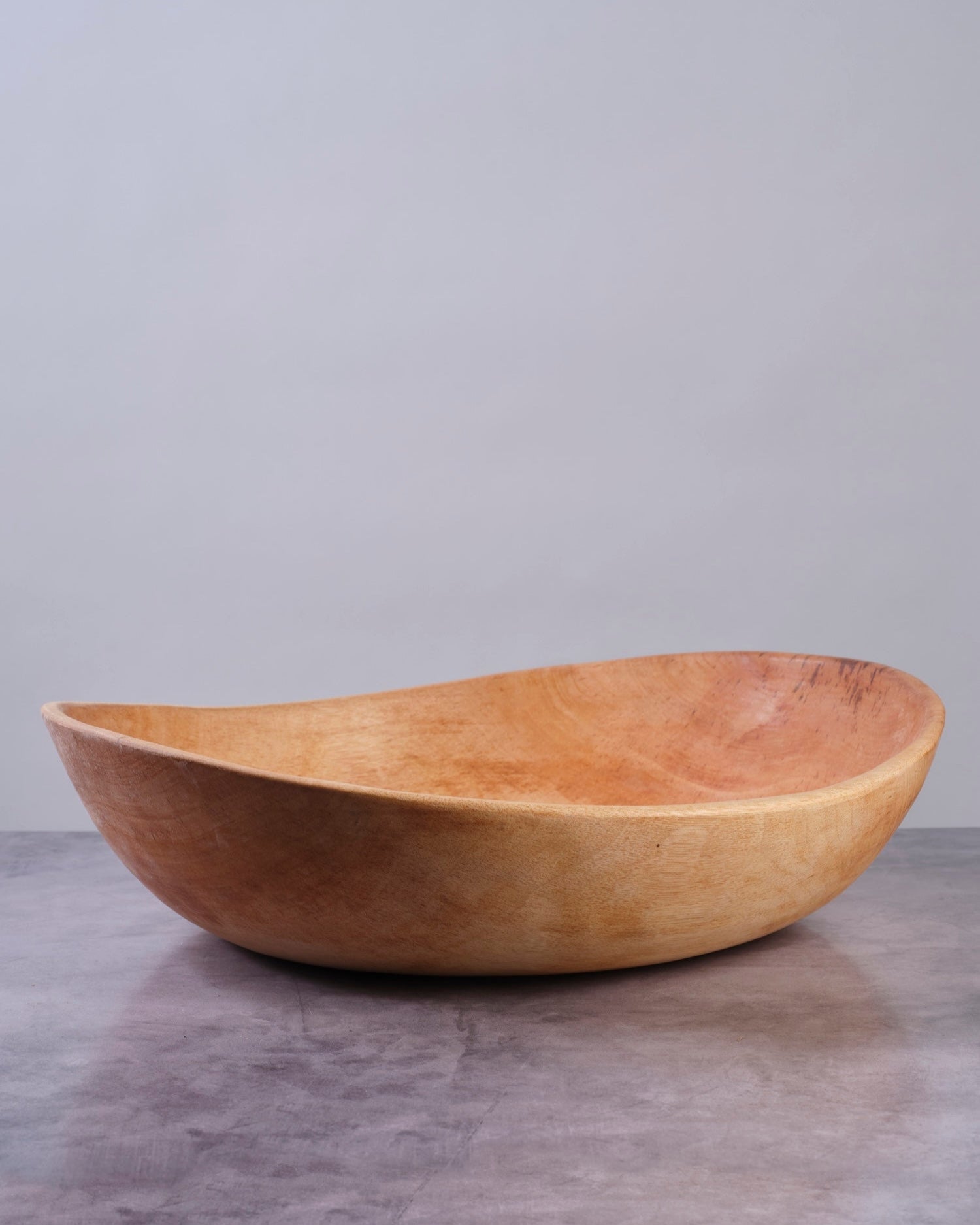
Most wooden bowls are turned on a lathe: a block of wood spins, a tool is held against it, and the shape is cut by rotation. Ours are not. Each TerraKlay bowl is hand-carved with chisels from a single block of Higuerilla hardwood by Yanesha artisans in the Peruvian Amazon, working through PaTS — Partners in Amazonian Tree Stewardship, a non-profit that works with the communities who steward those trees.
That changes three practical things about care:
None of this makes the bowls delicate. Our 24-inch bowl weighs about fifteen pounds. These are pieces meant to be on the table every week for decades, which is exactly why ten minutes a month is worth it. If you would like to see how they are made, here is the story behind these bowls.

Comments will be approved before showing up.