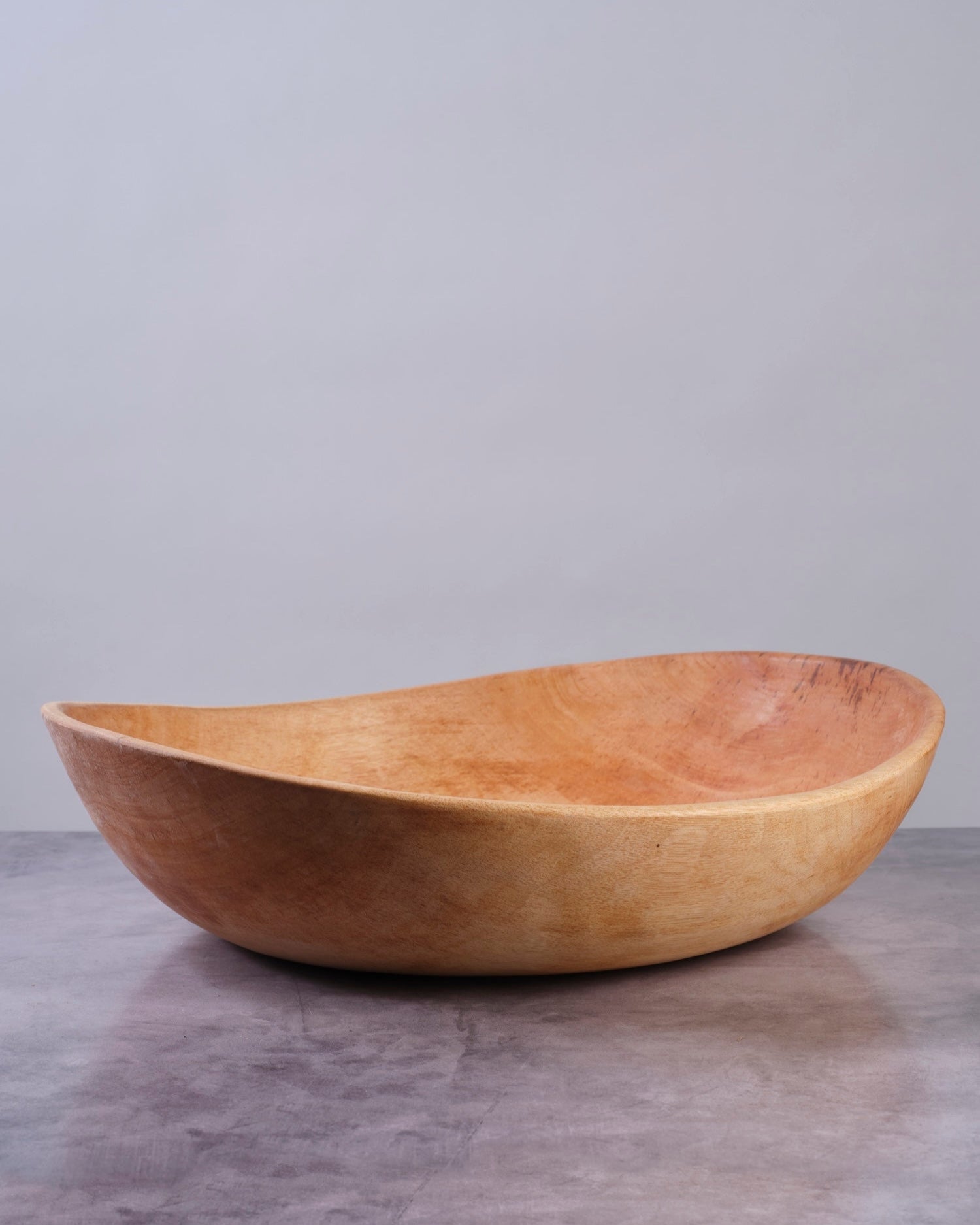
The pale rim and dark center of a solid hardwood bowl are sapwood and heartwood — the living outer wood and the retired inner wood of the same tree. The contrast is not a flaw, a stain, or a seam. It is the boundary between two stages of one tree's life, and on a bowl carved from a single block it is never in the same place twice.
By Manvee Vaid, founder of TerraKlay · August 2026
Pick up one of our bowls and you may see a rich, chocolatey brown base fading into a creamy, pale rim — or dark streaks running boldly through a lighter background. If you are used to factory-made or stained homewares, the first instinct is to wonder what went wrong.
Nothing did. The bowl was carved from one continuous block of a single tree, and what you are seeing is a cross-section of how that tree grew. Two zones, one piece of wood, no dye anywhere.
And it is worth saying plainly, because it is what surprises people most: every one of our bowls is solid. One block of hardwood, hollowed out by hand. No staves, no laminate, no joins — and no glue anywhere in it.
Sapwood is the outer wood, just under the bark. It is the active zone of the trunk — the part where cells are still alive, storing food and moving water and sap up from the roots — and because it has not yet accumulated the colored compounds of the core, it is the paler of the two.
Heartwood is the interior. As a tree lays down new wood on the outside, the oldest inner layers stop conducting and are retired into structural duty. During that transition the tree deposits extractives — resins, oils, tannins and phenolic compounds — into those cells. The extractives darken the wood, and they are also what makes heartwood naturally durable.
How much sapwood a tree carries varies widely. The Wood Handbook notes that vigorously growing trees tend to have wider sapwood, and that in some species it is only a centimeter thick while in others it runs 8 to 15 cm. That variation is one reason the light-to-dark ratio differs so much from bowl to bowl.
| Sapwood (the pale wood) | Heartwood (the dark wood) | |
|---|---|---|
| Where it sits | Outer trunk, under the bark | Inner core of the trunk |
| In the living tree | Active — stores food, conducts sap | Retired — provides structure |
| Color | Pale cream to light tan | Warm red through dark earth-brown |
| Strength | Species-dependent, and unmeasured for Higuerilla — see the next section for what our carvers observe | |
| Density | Slightly lower | Slightly higher — about 5% in one black walnut study |
| Decay resistance | Lower | Higher — the extractives act as a preservative |
| What it means indoors | Very little. Both zones are more than adequate for a bowl that is hand-washed and oiled. | |
This is the question we get most often about the color, and it deserves a careful answer rather than a confident one.
The carvers we work with handle Higuerilla every day, and they will tell you the heartwood and the sapwood do not behave the same under a chisel. That is first-hand knowledge of one specific wood from the people who cut it, and it is worth more than any generalization.
What the published research can say is narrower than the folklore suggests, and it is worth knowing where the two meet. A study of three oak species in Drvna Industrija compared sapwood against heartwood for density, bending strength, modulus of elasticity, compression strength and Brinell hardness and found no significant difference in any of them — the authors noted the result contradicts the common belief that sapwood is the inferior material. In some fast-growing species, eucalyptus and several pines among them, differences between the zones do come out significant. Where a density edge appears it is usually modest: a USDA Forest Service study of black walnut found sapwood averaging about 5% lower specific gravity than heartwood, 0.46 against 0.48.
So the strength difference is real in some woods and negligible in others. No published study has measured Higuerilla, which is why we would rather tell you what our carvers observe than borrow a conclusion from a different tree on the other side of the world.
What heartwood does reliably gain, across the literature, is resistance. The extractives laid down during heartwood formation work as a natural preservative against decay fungi and insects, and the USDA Forest Products Laboratory's Wood Handbook notes heartwood is also less susceptible to attack by acids and alkalis than sapwood is. Those properties matter enormously in a fence post or a boat hull, and almost not at all in a bowl that lives indoors, is hand-washed and gets oiled a few times a year.
For the bowl on your table, the practical answer is the simple one: the pale wood is not a weak spot. It is just younger.
This is where our bowls part company with most of the wooden bowls you will find.
A lathe-turned bowl is made by spinning a blank against a fixed tool. Every cut is a surface of revolution around one axis, so when the tool crosses the heartwood boundary it tends to reveal it as rings — roughly symmetrical, roughly centerd, repeating.
Our bowls are not turned. Each one is hand-carved with chisels from a single block of Higuerilla hardwood by Yanesha artisans in the Peruvian Amazon, working through PaTS — Partners in Amazonian Tree Stewardship, a non-profit that works with the communities who steward those trees. A carver is not constrained to a spinning axis. The bowl is placed within the block by eye, according to what that particular piece of wood is doing.
So the heartwood boundary arrives across the bowl at whatever angle the tree and the carver between them decided. It sweeps. It runs off one side. It pools in a base and never reaches a rim. Two bowls of the same size, cut from the same tree in the same week, will not carry the same pattern — and unlike a turned bowl, that asymmetry is not a defect in centering. It is the shape of a decision.
And there is no glue in any of it — not in the base, not at the rim, nowhere. A laminated bowl is built up from strips, and its seams show as straight, repeating lines that cut across the grain instead of following it. If you can see that, you are looking at a different kind of object.
No — and where the block is concerned, closer to the opposite.
A mill that wants uniform color cuts it away. Sapwood is trimmed off, or the piece is stained to hide the transition, and a good deal of sound wood goes to the offcut pile so that a set of bowls can look identical. Carving a bowl that carries both zones is the choice that wastes less of the tree.
And because heartwood only accumulates as a tree matures, a deep, wide band of dark wood tells you something real about the age of the tree it came from. That is not a marketing line. It is just what the color means.
We cannot control the color variation, and we would not want to. That is exactly what makes our bowls one of a kind. The pattern is settled by the tree long before a block ever reaches a carver, and no two blocks say the same thing — uniformity is what you get when a factory removes the evidence.
Wood is photosensitive, but the direction is not universal, and any article that tells you otherwise is overreaching. Some species deepen with light exposure — cherry is the classic example — while others bleach; walnut is well known for lightening. Oiling darkens both zones temporarily each time you do it.
So the honest answer for any particular bowl is that the contrast will shift over the first years rather than hold still, and that the shift is worth watching rather than worrying about.
The one change that is predictable is what happens without care: a bowl left to dry out goes pale, chalky and flat across both zones at once. Our guide to cleaning and caring for a wooden salad bowl covers the routine that prevents it — hand-wash, dry immediately, re-oil every four to six weeks.
Because it was carved from a single block that crossed the boundary between the tree's sapwood and its heartwood. The pale wood is the younger, outer, still-active part of the trunk; the dark wood is the retired core, colored by the extractives the tree deposited there. It is one piece of wood, not two joined together.
It depends on the wood, and for Higuerilla we go by what our carvers observe rather than by studies of other species. In the published research the picture is mixed: a study of three oak species found no significant difference between the two zones in density, bending strength, stiffness, compression strength or hardness, while some fast-growing species do show real differences. What heartwood consistently gains across the literature is decay and chemical resistance — which matters outdoors and very little in a serving bowl.
They will shift. Wood reacts to light, though whether it darkens or lightens depends on the species, and every oiling deepens both zones for a while. Expect the contrast to change character over the first few years rather than either vanish or sharpen.
One piece. Every TerraKlay bowl is carved from a single solid block of hardwood — no lamination, no staves, no joins and no glue anywhere in it. If a wooden bowl shows straight, repeating seams that cut across the grain rather than follow it, it was built up from strips instead of carved from a block.
Ask us and we will tell you honestly what is in stock. We cannot control the color variation and would not want to — it is what makes each bowl one of a kind, and the pattern is set before anyone picks up a chisel. But we can always look at what we have.
No. Wash, dry and oil the whole bowl the same way. The pale wood may take up a little more oil on the first few coats, which is normal and evens out.
No. There is no stain, dye or tint on our bowls at any stage. The color is the wood's own, and the finish is a food-safe oil.

At Shoppe Object New York, The Kitchn's editors picked 10 kitchen gems from the whole show. Our hand-carved 17-inch Wave bowl was one of them.

Written by the TerraKlay team, artisans dedicated to crafting heirloom-quality wooden bowls that celebrate natural beauty, sustainability, and everyday living. With years of experience in fair trade craftsmanship and ethical sourcing, TerraKlay brings mindful design and enduring materials to the modern home.

Here you will find Cindy’s top TerraKlay picks — artisan-made serveware, beautiful tabletop pieces, and timeless essentials that bring warmth and personality to every gathering. Each item reflects her love for baking, hosting, and setting a table that feels as special as the people around it.


We all have one family member or friend who’s impossible to shop for, so we’ll make it easy for you this year. Our Hot Chocolate Mugs Gift Box is the ultimate gift because who can resist a decadent cup of hot cocoa on a cold day? The gift box includes a tin of fair trade hot chocolate and two large handcrafted mugs, perfectly shaped to fit the palms of your hands and bring instant warmth. We’ve even wrapped the set for you so all you have to do is hand it over with a smile.

If you’re traveling for the holidays, you’ll want a hostess gift that can lay flat in your suitcase and still look fresh upon arrival. Our holiday embroidered hand towels are wonderfully festive and stocked in two gorgeous colors. The set comes with one striped bath towel and one hand towel, which are versatile and timeless. Then the present is topped with two embroidered wash cloths.The holly and candy cane embroidery adds a touch of whimsy to any bathroom or kitchen. This set is sure to charm any host.

Any home cook knows you can never have too many kitchen towels, but they’re not exactly an item you’re excited about buying yourself. Our kitchen towel gift set is a work of beauty. Complete with an olive wood spoon, it’s ideal for anyone on your list who cooks. The set includes two organic cotton towels, one of which has ties for a quick apron, and a wooden spoon to stir and mix all the hearty soups your loved ones will be making this winter. The whole package is put together in a cotton sleeve, complete with a bow.

Whether you’re welcoming a new neighbor or shopping for a friend who loves to host, deck their dining table with a set of colorful handmade napkins. One of our most popular products, the ombre napkins make the perfect gift. The traditional yet contemporary pattern is made using a centuries-old Japanese technique called shibori. Each napkin is individually hand-dyed and positively stunning. Stick with one color or mix and match any of the shades together for an unexpected touch. Whatever you do, just make sure to add another set to the cart for yourself because you’ll definitely want your own.

We’re not only keeping our friends and family close this holiday season, we’re keeping them cozy. Beautifully crafted and ethically hand-loomed by female artisans from the Himalayan belt, the Deepika Checkered Throw is the warmest way to give sustainable style. Made with 100% ethically sourced merino wool, angora wool, and natural dyes, our throw makes the perfect companion for lounging around the firepit or star-gazing. The Deepika Checkered Throw will be the most thoughtful gift for your loved ones to snuggle in and enjoy.

We’re all excited to sit down to a home cooked meal with our family and friends this holiday season. Our kitchen essentials basket is a winning present for aspiring cooks or seasoned chefs looking to upgrade their collection. All the items come in one handmade natural fiber basket that includes: two organic cotton dish towels, an olive wood spoon, solid olive wood rolling pin, and a half apron hand-loomed in 100% organic cotton. Plus, the basket is strategically designed to be reused as a catchall or planter. Your loved ones are bound to think of you everytime they use an item from this set, which will be daily.

In 1976, a group of visionary artisans in the quaint village outside Antigua, Guatemala, came together to forge a path towards economic independence. Driven by the desire to secure a living wage, health insurance, and a better future for their families, they formed an artisan-owned cooperative. With a small loan, they purchased land and built a kiln and workspace where they could craft their trade.
Four decades on, this cooperative continues to thrive, transforming recycled glass into exquisite glassware. The group holds fast to their foundational principles of fair employment and environmental stewardship, making a significant impact in their community.
Today, the cooperative supports around 35 local men, creating a robust environment where artisans from the village can prosper. Many of these artisans have dedicated up to 30 years to their craft, achieving personal milestones such as homeownership and providing better opportunities for their families. The younger generation of artisans also sees the benefits, gaining access to safer transportation and improved living conditions.
The cooperative remains unique in Guatemala, dedicated exclusively to creating blown glass pieces. Artisans enjoy access to fair wages, health benefits, and opportunities for personal and professional development, all within a dignified and safe working environment.
The process of making their renowned glassware starts with locally sourced recycled glass, which is meticulously cleaned and broken down into smaller pieces. The glass is then melted down and crafted into beautiful items. Artisans work with basic hand tools—like tweezers, scissors, and blow tubes—to meticulously shape each piece, occasionally using aluminum molds for specific designs. This manual process highlights the artisan's skill and the personalized touch in each piece of glassware.
Through their dedication and skill, these artisans not only preserve traditional techniques but also promote sustainable practices within their community, offering a model of how traditional crafts can adapt to modern demands while supporting the artisans and their environments.


In Antigua, a collective of artisans is generating sustainable, long-term income through collaborative and innovative practices, sparking significant social change. By blending ancestral techniques with contemporary demands, we effectively preserve Guatemala's rich cultural heritage. We create unique, innovative, and high-quality products, such as TerraKlay's cutting and charcuterie boards, crafted with care, humanity, and sustainability at their core. Our collaborations are breaking the cycle of poverty by providing financial stability to skilled artisans and their communities, helping to maintain Guatemalan traditions that have spanned generations, and infusing warmth and humanity into the global marketplace.
Each product we offer carries a rich history of traditional techniques, patterns, and cultural significance, which we are honored to share with you.

The bowl Daphne Oz uses is a 20-inch salad bowl hand-carved from a single block of Higuerilla hardwood — the one she told her followers to find by searching “higuerilla 20″ wood bowl.” This is the Extra Large (XL) 20 inch Classic Round Wood Bowl. The same shape is also carved in 17 and 24 inches.
By Manvee Vaid, TerraKlay · Updated August 2026
On Super Bowl Sunday 2021, Daphne Oz posted a kale, apple and farro salad under a caption only she could have written: “super BOWL!! 🥗😋”. The salad looked wonderful. The comments wanted to talk about something else entirely — the enormous hand-carved bowl it arrived in, the one she called “this mega wooden bowl I use all the time.”
Here is the part we love. She had bought it years earlier at a little home goods store in Portland, Maine that has since closed, so she could easily have shrugged and moved on. Instead she tracked down the source and told everyone exactly what to search for — “higuerilla 20″ wood bowl” — then linked it in her Instagram stories. “Each one is hand carved and unique,” she wrote. She is right; that is precisely how they are made.
A few weeks later came the Caesar: her grandmother's famous egg-less Caesar salad, mashed and tossed start to finish in the same giant bowl — “garlicky, lemony, cheesy, crunchy deliciousness” — and watched more than three million times. The salad went viral. The bowl went with it.
Watch Daphne Oz make her grandmother’s Caesar salad in the giant wooden bowl — on Instagram
People have been arriving here ever since, usually mid-craving. One review on the bowl's product page opens: “A big shout out and thanks to Daphne Oz for sharing her treasured salad bowl and where she sourced it.”
So this page answers what those people are actually asking: which bowl is it, what size, and where do you get one.
When she said to search for a “higuerilla 20″ wood bowl,” this is where that search leads. It is the 20-inch Classic Round wood bowl — the size we list as Extra Large. Twenty inches across is bigger than most people picture: it holds a salad for a table of ten, and it is the size that reads as a statement piece on a counter rather than a serving dish in a cupboard.
The same shape is carved in four sizes. If 20 inches is more bowl than you need, the 17 is the one most people land on.
| Size | What it suits | |
|---|---|---|
| 14 inch — Medium | Everyday salads for two to four; fruit on a counter | 14 inch |
| 17 inch — Large | Family dinners and most entertaining. The popular size. | 17 inch |
| 20 inch — Extra Large | The size in the video. A table of ten; a statement piece. | 20 inch |
| 24 inch — XXL | The largest we make. Holidays, big gatherings, or display. | 24 inch |

Every one of these bowls is carved by hand from a single solid block of Higuerilla — an Amazonian hardwood — by Yanesha artisans in Peru, working through Partners in Amazonian Tree Stewardship, a non-profit that works with the communities who steward those trees. The wood is sourced from managed forests evaluated for compliance with local law, for respect for indigenous peoples and the Amazon's ecosystem, and for the safety and rights of the people doing the work. They use the whole tree, trunk to top; little is wasted.
Two things follow from that, and they are worth knowing before you buy.
They are solid. One block of hardwood, hollowed out. No staves, no laminate, no joins, and no glue anywhere in the bowl.
No two are the same. The pale and dark areas are the tree's sapwood and heartwood, and where the boundary falls is decided by the tree, not by us — which is exactly what makes each one different. If you want the detail, we wrote it up in why wooden bowls vary in color.
It also means the bowl you receive will not be identical to the one in the video. It will be the same size, the same shape and the same wood — but its own piece.
Twenty inches across. That is our Extra Large size, and it is noticeably bigger than a standard serving bowl — enough salad for a table of ten.
The 20-inch Classic Round wood bowl is available here, hand-carved and in stock at $425. It is the same bowl in the same size.
Because she kept making very large salads in a very large bowl, people kept asking, and she eventually told everyone what to search for: “higuerilla 20″ wood bowl.” Between the super BOWL kale salad and her grandmother's Caesar — viewed more than three million times — the bowl became the most famous thing on her table.
The two famous ones are a kale, apple and farro salad with lemon-maple vinaigrette — the “super BOWL” salad — and her grandmother's egg-less Caesar, which she mashes and tosses entirely in the bowl. The Caesar recipe is on her site; the bowl's job is to be big enough for it.
Same size, same shape, same wood — but not the same markings. Each bowl is carved from its own block, and the pattern of pale sapwood and dark heartwood is unique every time! That is the nature of the wood, and we love that!
Yes. The 24-inch is the largest size.
Hand-wash in warm water with mild soap, towel-dry immediately, and re-oil with food-grade mineral oil every four to six weeks. Never the dishwasher. The full routine is in our guide to cleaning and caring for a wooden salad bowl.
Yes — finished with a food-safe oil and intended for serving. Keep it dry between uses and it will outlast most of what is in your kitchen.

The Chicago-Chakouri Knitting Project is a collaborative effort that brings together six non-profits and two social enterprises from around the United States.
What began as a plan to link two non-profit organizations in Chicago quickly evolved into a cross-cultural initiative that linked Chicagoans with women knitters in Chakouri, India, on the other side of the world.
Due to a grant from the Simmons Center of Global Chicago, this project has become possible. The knitters are members of the fair trade women's knitting collective Himalayan Naari.
Everyone in Chicago who is interested is welcome to participate in the project, but it is especially focused on involving youth to motivate and engage them to become fair trade proponents. The Chicago Fair Trade (CFT) Museum will be hosting an exhibit as well as a knitting circle from April 14 to May 14, 2023 to feature the women knitters. Participants are invited to knit a square that will eventually form part of a blanket.
The blanket will be assembled from the knitted squares during the World Fair Trade Day Celebration on May 14 -15 at the CFT Museum.

TerraKlay, a CFT business member, is involved in the project. Manvee Vaid of TerraKlay, also being a director at Himalyan Naari and is the point of contact with the women knitters.
The patchwork blanket creates a sense of unity by bringing together individuals from various backgrounds and representing a collage of ideas, cultures, and people. The love for this project builds a strong community among those involved.

The Chaukori Patchwork Blanket is unique with its own distinct pattern and color scheme, and it's hand-knitted and finished in 4 weeks, ensuring that they are not only beautiful but also durable and long-lasting. No two blankets are alike.
What's exciting is that you can own one of the beautiful Chaukori Patchwork Blankets! These blankets are truly one-of-a-kind, hand-knitted with love and care by skilled artisans at Himalayan Naari.
As a part of their commitment to fostering relationships with the artisans and the community, the blankets are being offered at a special pre-order price of $449, originally priced at $550. By purchasing one of these blankets, you'll be directly supporting the artisans and the knitting they are involved in.
This is a special offer that won't last forever, so take advantage of this amazing opportunity to own a hand-knitted Chaukori Patchwork Blanket and support the artisans in their craft. It's a chance to experience the warmth and comfort of these beautiful blankets in your own home while making a difference in the lives of the women knitters in Chakouri.
We extend a special thank you to Kristine Brandel for generously volunteering her time, sharing her passion for knitting, and offering her expertise. We also express our gratitude to the following organizations for making this project possible:

After China, India is the second-largest producer of cotton. Around 5.8 million farmers grow cotton with many millions more working within India’s cotton industry.
India has been producing cotton for textiles and various products for thousands of years and it is one of its most important exports.

It is a device used by weavers to weave fabric by interlacing warp and weft threads. A hand loom allows the weaver to create cloth faster and more evenly by providing tension on the warp threads. Hand looms range in complexity from simple, portable backstrap looms to complex, room-sized jacquard looms. Handloom fabric is typically made from natural fibers such as cotton, silk, and wool.Handloom products are timeless
Every aspect of handloom fabrics is created manually, by hand. Fibres are spun and woven in-house and no two fabrics are the same. Handloom fabrics reflect the artisan who has woven them, creating unique, timeless works of art.

TerraKlay is excited to be partnering with cooperatives in South India. Giving farmers who use rainfed agricultural methods, global connections and opportunities to sell their products.
TerraKlay's cotton handloom towels, including hand towels, bath towels, and kitchen towels, are made entirely from local materials, preserving traditional skills. Our collaborations benefit farmers' livelihoods and long-term agricultural practices, and we take pride in promoting ethical and fair business practices across our organization.
Our women artisans make each handloom towel with commitment and appreciation, knowing that they will be able to provide for their families and share their traditional craft with the rest of the world.
So, the next time you search the Internet for towels and decide to buy Turkish towels, keep in mind that there is a better option.
Towels made of 100% organic cotton handloomed by TerraKlay. We're thrilled that, as part of our commitment to sustainability, we can offer products that are as functional as they are beautiful. Use them as bathroom towels, beach or pool towels, picnic blankets. They are highly absorbent, light weight and absorbent. Honestly better than most Turkish towels in the market today.

All TerraKlay’s products are named after the amazing artisans who craft them and we can’t wait to expand to include all the talented women at Himalayan Naari. Join us for an interview with Kathleen Bollerud, the founder of this fair trade, non-profit organization that has been dedicated to improving the lives of women and girls in Northern India for the last 13 years.
They say everything happens for a reason, and I believe that is true. One trip to India changed my life. After traveling with a tour guide, we ventured north to a timeshare we had been told about and discovered the beautiful villages and scenery of the Himalayas. It quickly became apparent that the lives in this region was quite difficult, especially for women and girls. There was limited education and few prospects them. We decided to help and through the Himalayan Education Foundation (HEF) began providing scholarships for girls from remote rural villages. Over the years, we were able to bring many girls to our school and they have done very well.
Around 2012, one of the student's mothers asked “What will you do for the women?” I was completely floored; we had not thought about it. In meeting with the women, it quickly became obvious the sacrifices these mothers were making to send their children to school in the hope of a better life.

They lived in one room with their children, away from their home farms, with no gardens, animals, or income. These women desperately wanted to be able to provide for themselves. As we were meeting, we noticed that all the women were knitting. Through HEF, we agreed to provide the women with good quality wool and try and sell their knitting in the USA. This was the birth of Himalayan Naari.

The first challenge we faced was getting to the villages in the first place. We didn’t know about the wet monsoon season and most of the roads had been washed away and were dangerous to drive on.
We decided to walk as we saw many other Indian’s doing and that is how we met some Kumaon women carrying heavy loads down the trails.

Along this journey, there have been many challenges to overcome. It has been amazing, but we believe that when you need help, people will come. We have found and worked with so many wonderful people along the way, who have helped us set up and teach a variety of skills such as computer science, dairy farming, and sewing reusable sanitary products.
The first bundle of knitting brought to the USA was knit well but the finishing was not good enough for the western market. We spend 9 months of training to upskill the artisans. Now, their products are exquisitely finished every time. We, then, began to making hats and mittens, which are still some of our more popular items today.
After discovering the lonely and isolated lives of the mothers in Chakouri, we brought them together to create Himalayan Naari. After renting a place for them to meet, they quickly realized that they needed a Women’s Center to develop their own community.

In 2013 women from the northern village of Munsiyari asked to join the project. They are weavers and create stunning handwoven blankets and products. Their craft was dying out without a means to sell their products. By selling their products in the US, Himalayan Naari has given them back economic independence, which is our main goal.
In 2022 the women's group had expanded to 57 knitters, 4 employees. We have almost eliminated anemia through our nutrition project and have just secured free medical, dental, and vision tests for 2023 for all artisans.
The women's group outgrew their first building after a few years. Since then, we have built a large women’s center with assistance from Himalayan InterCollege (HIC), the local school. We now have a local store for selling products, a workshop, a kitchen, and wool storage area. Our goal is to teach women how to become entrepreneurs and create their own financial stability.
We have also been given 6 acres of land by HIC which contained a tea plantation. The women farm this land, growing vegetables and selling them to the school. This collaboration provides income for the women and helps to improve diets and eradicate malnutrition. Each year we also receive assistance through grants and donations to help us continue to grow.

Wherever possible we use natural materials and dyes. Wool is sourced from shepherds whose sheep graze in the Himalayan mountains between Tibet and Nepal. The wool is handspun and of high quality.
We also use cotton, fine wool, and dye fibers with natural plant dyes, to help look after our environment. Some people cannot tolerate wool; we do make products of high quality blends that are manufactured according the highest environmental standards.
We are excited to partner with Manvee Vaid and TerraKlay. Manvee brings a strong business sense and more experience in retail and design. We have known her for several years and hope she will continue with us on our journey. With the TerraKlay partnership, we hope to increase the entrepreneurism of Naari members and continue to grow the number of women artisans.
TerraKlay is thrilled to be a part of this journey. Check out our handcrafted woolen blankets that resulted from this collaboration.

On cold winter nights, all you want to do is curl up in a warm blanket and watch Netflix or reading a book while sipping a warm beverage like hot chocolate or tea.
TerraKlay handmade throw blankets exemplify the beauty of natural materials and simple colors. One that will keep you warm, can be passed down as an heirloom, and will last a long time.

Surely there can’t be that much difference, except the handmade blankets can take longer to make?
That’s where you’d be wrong. A hand-woven or knitted blanket is more than just a blanket; it's the story of the women artisan who crafted it, it's the love and attention to detail that went into creating that blanket for you and it is the commitment to keeping old traditions alive.
During the first wave of the pandemic in 2020, I started working with two small groups of women artisans in North India. Situated in the beautiful terrain of Uttarakhand around 15 hours north of the capital Delhi. We first communicated by email but this soon led to phone calls. Over many hours we formed deep connections and shared family stories as well as conversed about business. Distance became irrelevant.

One group of women, Maati Sangathan (Women Collective) have worked together since the 90s and work hard to promote women's rights and help enable them to make money at home and a supportive community. TerraKlay works with 10 women artisans who hand weave our blankets using all local wool, all naturally dyed.

The other group of women, the Himalayan Naari (Himalayan Women) are knitters located in Chakouri. TerraKlay collaborates with 50 knitters, to knit our throw blankets. They also knit woolen mittens, caps and other winter products. They work to improve their lives, showing that they can be financially independent and work from home even in rural, mountainous regions.

Our artisans use handlooms and knitting to create beautifully crafted traditional wool textiles.
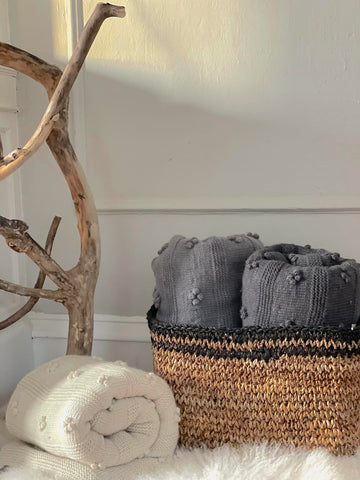
Our luxury knitted blankets are lovingly created using 100% Merino wool. It takes about 3-4 weeks to complete one knitted blanket and nearly weighs 4 pounds. Our blankets drape elegantly over furniture, ready to provide warmth and comfort on a cold winter's night. Our artisans create a small range of stylish hand-crafted knitted blankets from the comfort of their own homes. A perfect metaphor as the finished blankets is a welcome addition to your home.

Our woven blankets are made using a variety of wool mixes, primarily Merino and cruelty-free Angora wool all naturally dyed. Making them super soft, plush, and warm, our blankets come in a range of colors, and complimentary shades of gray, brown, and white make our blankets the perfect gift for any home. Hand weaving is a craft that has been passed down through generations, our artisans are helping keep this traditional craft alive and creating stunning products to share with you at the same time.