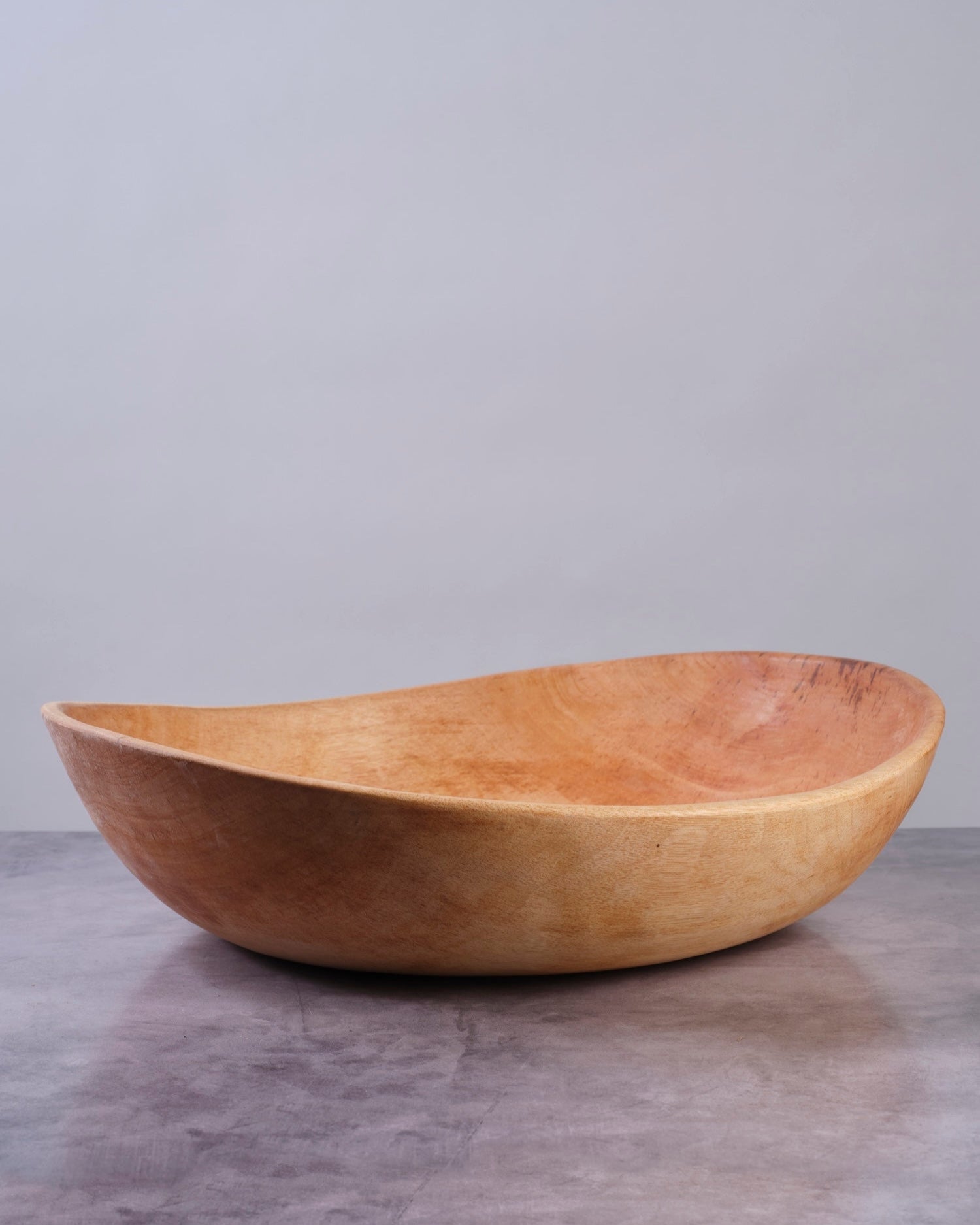
The pale rim and dark center of a solid hardwood bowl are sapwood and heartwood — the living outer wood and the retired inner wood of the same tree. The contrast is not a flaw, a stain, or a seam. It is the boundary between two stages of one tree's life, and on a bowl carved from a single block it is never in the same place twice.
By Manvee Vaid, founder of TerraKlay · August 2026
Pick up one of our bowls and you may see a rich, chocolatey brown base fading into a creamy, pale rim — or dark streaks running boldly through a lighter background. If you are used to factory-made or stained homewares, the first instinct is to wonder what went wrong.
Nothing did. The bowl was carved from one continuous block of a single tree, and what you are seeing is a cross-section of how that tree grew. Two zones, one piece of wood, no dye anywhere.
And it is worth saying plainly, because it is what surprises people most: every one of our bowls is solid. One block of hardwood, hollowed out by hand. No staves, no laminate, no joins — and no glue anywhere in it.
Sapwood is the outer wood, just under the bark. It is the active zone of the trunk — the part where cells are still alive, storing food and moving water and sap up from the roots — and because it has not yet accumulated the colored compounds of the core, it is the paler of the two.
Heartwood is the interior. As a tree lays down new wood on the outside, the oldest inner layers stop conducting and are retired into structural duty. During that transition the tree deposits extractives — resins, oils, tannins and phenolic compounds — into those cells. The extractives darken the wood, and they are also what makes heartwood naturally durable.
How much sapwood a tree carries varies widely. The Wood Handbook notes that vigorously growing trees tend to have wider sapwood, and that in some species it is only a centimeter thick while in others it runs 8 to 15 cm. That variation is one reason the light-to-dark ratio differs so much from bowl to bowl.
| Sapwood (the pale wood) | Heartwood (the dark wood) | |
|---|---|---|
| Where it sits | Outer trunk, under the bark | Inner core of the trunk |
| In the living tree | Active — stores food, conducts sap | Retired — provides structure |
| Color | Pale cream to light tan | Warm red through dark earth-brown |
| Strength | Species-dependent, and unmeasured for Higuerilla — see the next section for what our carvers observe | |
| Density | Slightly lower | Slightly higher — about 5% in one black walnut study |
| Decay resistance | Lower | Higher — the extractives act as a preservative |
| What it means indoors | Very little. Both zones are more than adequate for a bowl that is hand-washed and oiled. | |
This is the question we get most often about the color, and it deserves a careful answer rather than a confident one.
The carvers we work with handle Higuerilla every day, and they will tell you the heartwood and the sapwood do not behave the same under a chisel. That is first-hand knowledge of one specific wood from the people who cut it, and it is worth more than any generalization.
What the published research can say is narrower than the folklore suggests, and it is worth knowing where the two meet. A study of three oak species in Drvna Industrija compared sapwood against heartwood for density, bending strength, modulus of elasticity, compression strength and Brinell hardness and found no significant difference in any of them — the authors noted the result contradicts the common belief that sapwood is the inferior material. In some fast-growing species, eucalyptus and several pines among them, differences between the zones do come out significant. Where a density edge appears it is usually modest: a USDA Forest Service study of black walnut found sapwood averaging about 5% lower specific gravity than heartwood, 0.46 against 0.48.
So the strength difference is real in some woods and negligible in others. No published study has measured Higuerilla, which is why we would rather tell you what our carvers observe than borrow a conclusion from a different tree on the other side of the world.
What heartwood does reliably gain, across the literature, is resistance. The extractives laid down during heartwood formation work as a natural preservative against decay fungi and insects, and the USDA Forest Products Laboratory's Wood Handbook notes heartwood is also less susceptible to attack by acids and alkalis than sapwood is. Those properties matter enormously in a fence post or a boat hull, and almost not at all in a bowl that lives indoors, is hand-washed and gets oiled a few times a year.
For the bowl on your table, the practical answer is the simple one: the pale wood is not a weak spot. It is just younger.
This is where our bowls part company with most of the wooden bowls you will find.
A lathe-turned bowl is made by spinning a blank against a fixed tool. Every cut is a surface of revolution around one axis, so when the tool crosses the heartwood boundary it tends to reveal it as rings — roughly symmetrical, roughly centerd, repeating.
Our bowls are not turned. Each one is hand-carved with chisels from a single block of Higuerilla hardwood by Yanesha artisans in the Peruvian Amazon, working through PaTS — Partners in Amazonian Tree Stewardship, a non-profit that works with the communities who steward those trees. A carver is not constrained to a spinning axis. The bowl is placed within the block by eye, according to what that particular piece of wood is doing.
So the heartwood boundary arrives across the bowl at whatever angle the tree and the carver between them decided. It sweeps. It runs off one side. It pools in a base and never reaches a rim. Two bowls of the same size, cut from the same tree in the same week, will not carry the same pattern — and unlike a turned bowl, that asymmetry is not a defect in centering. It is the shape of a decision.
And there is no glue in any of it — not in the base, not at the rim, nowhere. A laminated bowl is built up from strips, and its seams show as straight, repeating lines that cut across the grain instead of following it. If you can see that, you are looking at a different kind of object.
No — and where the block is concerned, closer to the opposite.
A mill that wants uniform color cuts it away. Sapwood is trimmed off, or the piece is stained to hide the transition, and a good deal of sound wood goes to the offcut pile so that a set of bowls can look identical. Carving a bowl that carries both zones is the choice that wastes less of the tree.
And because heartwood only accumulates as a tree matures, a deep, wide band of dark wood tells you something real about the age of the tree it came from. That is not a marketing line. It is just what the color means.
We cannot control the color variation, and we would not want to. That is exactly what makes our bowls one of a kind. The pattern is settled by the tree long before a block ever reaches a carver, and no two blocks say the same thing — uniformity is what you get when a factory removes the evidence.
Wood is photosensitive, but the direction is not universal, and any article that tells you otherwise is overreaching. Some species deepen with light exposure — cherry is the classic example — while others bleach; walnut is well known for lightening. Oiling darkens both zones temporarily each time you do it.
So the honest answer for any particular bowl is that the contrast will shift over the first years rather than hold still, and that the shift is worth watching rather than worrying about.
The one change that is predictable is what happens without care: a bowl left to dry out goes pale, chalky and flat across both zones at once. Our guide to cleaning and caring for a wooden salad bowl covers the routine that prevents it — hand-wash, dry immediately, re-oil every four to six weeks.
Because it was carved from a single block that crossed the boundary between the tree's sapwood and its heartwood. The pale wood is the younger, outer, still-active part of the trunk; the dark wood is the retired core, colored by the extractives the tree deposited there. It is one piece of wood, not two joined together.
It depends on the wood, and for Higuerilla we go by what our carvers observe rather than by studies of other species. In the published research the picture is mixed: a study of three oak species found no significant difference between the two zones in density, bending strength, stiffness, compression strength or hardness, while some fast-growing species do show real differences. What heartwood consistently gains across the literature is decay and chemical resistance — which matters outdoors and very little in a serving bowl.
They will shift. Wood reacts to light, though whether it darkens or lightens depends on the species, and every oiling deepens both zones for a while. Expect the contrast to change character over the first few years rather than either vanish or sharpen.
One piece. Every TerraKlay bowl is carved from a single solid block of hardwood — no lamination, no staves, no joins and no glue anywhere in it. If a wooden bowl shows straight, repeating seams that cut across the grain rather than follow it, it was built up from strips instead of carved from a block.
Ask us and we will tell you honestly what is in stock. We cannot control the color variation and would not want to — it is what makes each bowl one of a kind, and the pattern is set before anyone picks up a chisel. But we can always look at what we have.
No. Wash, dry and oil the whole bowl the same way. The pale wood may take up a little more oil on the first few coats, which is normal and evens out.
No. There is no stain, dye or tint on our bowls at any stage. The color is the wood's own, and the finish is a food-safe oil.
Comments will be approved before showing up.