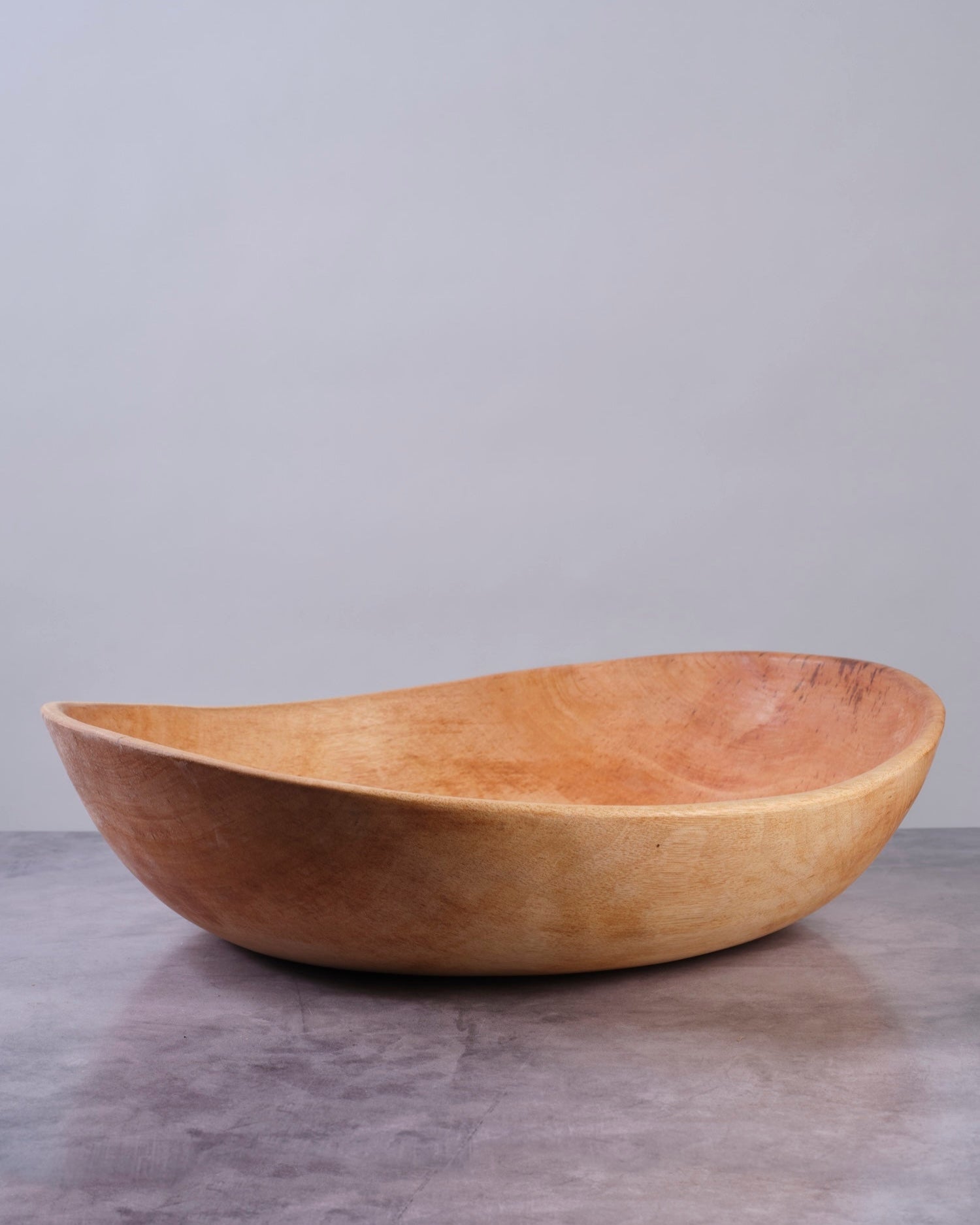
I recently returned from a show where I displayed our entire wooden bowl collection. The big ones. The really big ones. And everything in between.
Our 24-inch wooden bowls, smaller 15-inch handled bowls, dough bowls, and 21-inch serving platters. I wanted people to see what these bowls could be—not just a bowl to serve salad in, but beautiful pieces of wood, shaped by hand, with a life and character of their own.
People stopped. They looked. They touched.
They admired the grain, the knots, the texture of the wood, and even the chisel marks that tell you these bowls were carved by hand. They asked where they were made, how they were carved, what kind of wood was used, and whether they were food safe.
I heard, “Oh, what a beautiful bowl!”
“Look at the size of that!”
“I could see this on my kitchen island.”
“This would be gorgeous on my dining table.”
And then, quite often, they walked away.
Not because they didn't like the bowls. Quite the opposite. They loved them.
But then came the reasons.
“It's too big.”
“Where would I keep it?”
“My cabinets aren't big enough.”
“I already have so many wooden bowls.”
“I got one from my mother.”
“We don't cook anymore. The kids just order Uber Eats.”
“Let me think about it.”
I heard all of these. Probably a few more.
And I understood.
A wooden salad bowl isn't always an impulse purchase. Especially a large one. You don't necessarily walk into a holiday show surrounded by leather bags, jewelry, candles, perfume, chocolates, and beautiful clothing and suddenly decide that what you really need is a hardwood bowl.
A bowl is different.
You sit with it. You look at it. You run your hand over it. You imagine it in your home. You wonder where it will live, what you will put in it, and whether it belongs in your space.
And that got me thinking.
Maybe there really are 100 reasons not to buy a wooden bowl.
But what about the reasons to have one?
There is something about wood that simply cannot be replicated.
The grain is never quite the same. The knots, the natural color variations, the texture, and the marks left by the artisan make every wooden bowl unique.
You can touch it. You can feel its warmth. It doesn't feel manufactured to look exactly like the next one.
In a world where so many things are mass-produced, a handcrafted wooden bowl brings a little bit of nature indoors. A reminder that beautiful things don't have to be perfect to be extraordinary.
Sometimes, the beauty is in the imperfections.
We often talk about traditions as something we inherit. A recipe passed down. A familiar holiday ritual. A dish that appears on the table every Thanksgiving, no matter what.
But traditions have to start somewhere.
Imagine bringing out the same wooden salad bowl for every family gathering. The Thanksgiving salad. The summer tomatoes. The fruit on the kitchen island. The bread at Sunday dinner.
Years from now, someone might remember it.
“That's the bowl Mom always used.”
“We always had the salad in that bowl.”
“That bowl came out every Thanksgiving.”
We spend so much time buying things that are quickly forgotten. What if we bought one thing that became part of our family's memories?
Maybe that's how the next generation's traditions begin.
We live in a world of abundance. We have bowls, platters, containers, serving dishes, and things we bought because they were on sale, because they were cute, or because we thought we might need them someday.
But perhaps there is something to owning fewer things and choosing them more thoughtfully.
One beautiful wooden salad bowl that you bring out again and again. One piece that earns its place at the table. One that serves, gathers, holds, and gets better with time.
It doesn't need to be used every day to be useful. And it doesn't need to be hidden away waiting for a special occasion.
The best things in our homes are often the ones that become part of our everyday lives.
A large wooden bowl has a presence.
On a kitchen island, it catches your eye. On a dining table, it brings the room together. On a console, it becomes the piece that makes people stop and ask, “Where did you get that?”
You don't need to fill every corner of your home. You don't need another decorative object. Sometimes one beautiful, thoughtfully made piece is enough.
A wooden bowl can be functional, sculptural, and beautiful all at once.
And the best part? It doesn't need to be rearranged every season to make it feel relevant.
A bowl is, at its heart, a vessel for sharing.
A salad passed around the table. Fruit offered to a guest. Bread brought out for everyone. A bowl of something delicious placed in the middle, where everyone reaches in.
There is something wonderfully uncomplicated about that.
Our wooden bowls are made by hand, shaped by artisans, and inspired by the natural material they work with. They carry the marks of the process rather than hide them.
And perhaps that's what makes them special. They're not just meant to sit and be admired. They're meant to be brought out, filled, used, shared, and lived with.
 photo credit : Cindy Richter
Probably not.
But perhaps you don't need another candle, another decorative object, another thing that will eventually find its way into a drawer, either.
Perhaps what you need is one piece that makes you stop for a moment. One that reminds you of nature. One that brings people to the table. One that you will use today, next year, and perhaps one day pass on.
We understand that a wooden bowl isn't for everyone. And we certainly don't believe in buying things just for the sake of buying them.
But if a piece speaks to you, if you find yourself running your hand over the grain, imagining it on your island, or picturing it filled with food at your next family gathering, perhaps that is reason enough.
As a mother of two, with kids in their early twenties, I think about this a lot.
I know a large, handcrafted wooden bowl isn't necessarily something a young person in their twenties is going to spend their money on. It may not fit their budget, their lifestyle, or even their apartment. And that's perfectly okay. I'm not suggesting they should.
But I do think there is value in introducing them to things that are made with care, helping them understand why something is made the way it is, where it comes from, who made it, and why it might be worth keeping.
Today's younger generation is surrounded by an extraordinary amount of information, choices, trends, and products. Everything is constantly being presented to them as something they need, something they should have, or something they shouldn't miss out on. Sometimes, I wonder if in all that noise, it becomes harder to recognize what truly matters to us—and what we want to hold on to.
Maybe that's where we begin. Not with buying more, but with learning to appreciate more.
Understanding the difference between something we want for a moment and something we want to live with for years. Learning to buy less, but buy better. Choosing things that have meaning, that tell a story, that remind us of people, places, or moments in our lives.
And perhaps traditions don't have to be inherited. Perhaps we can create new ones, intentionally. A piece we bring out every holiday. A meal we make together. Something we choose to keep, use, and pass along—not because it is expensive or valuable, but because it means something to us.
I hope my children, and the next generation, learn that value isn't always measured by price, quantity, or what's trending. Sometimes it's measured by how long something stays with us, how often it brings people together, and the memories attached to it.
Make room for one beautiful thing. Make room for a tradition. Make room for gathering.
That's what we hope our bowls become.
— Manvee

To care for a wooden cutting board, wash it by hand in warm water with a drop of dish soap, wet both faces, towel-dry it, and stand it on edge to finish drying. Oil it with food-grade mineral oil once a month, sooner if water soaks straight in rather than beading. Never use the dishwasher, and never let it soak.
That paragraph is the whole job. The rest is the reasoning and the edge cases: why drying flat warps a board, which oils are safe, what to do when the surface feels fuzzy.
Why never the dishwasher: a dishwasher holds the board in hot standing water and degreasing detergent for the better part of an hour — enough to strip the finish, raise the grain, crack a solid board, and start working open the glue joints in a pieced one.
Why never a soak: soaking is the dishwasher without the heat. The wood swells, the grain lifts, and the board comes out rough and pale. If something has dried on, hold the board under running water and scrub — a minute of patience shifts anything a soak would.
Wood swells as it takes water in and shrinks as it dries. A warped board is almost never a defective board — it is a board whose two faces dried at different speeds.
Lay a damp board flat on the counter and only the top face can dry. The top shrinks while the underside, sealed against the countertop, stays swollen, and the board cups — curls up across its width. The same thing happens in slow motion to a board always washed on one side, or stored with one face toward the stove's heat.
Standing the board on edge removes the whole problem: both faces meet the air and dry at the same rate, and the board stays flat. Keep it away from radiators, direct sun and the oven's warmth while it dries — fast drying is uneven drying.
How often: about once a month with regular use. A new board, or one you have just sanded, drinks more — oil it weekly for its first month. Dry winter air pulls moisture out faster, so tighten the schedule through winter.
The water-bead test takes out the guesswork. Sprinkle a few drops of water on the surface. If they sit up in beads, the finish is still doing its work. If they flatten and soak straight in, darkening the wood, the board is due.
Which oil: food-grade mineral oil, USP grade. It is inert, tasteless and allergen-free, and — the property that matters most — it does not oxidize, so it can sit in the wood indefinitely without going rancid. Olive, vegetable, canola and sunflower oil are cooking oils, and they behave in a board the way they behave in a forgotten frying pan: they oxidize, turn sticky, and leave a stale smell that is very hard to get out. Rubbing in olive oil is the most common way a good board is spoiled at home. Our Wood Conditioning Kit pairs a food-safe board oil with a microfiber cloth — it is what we use on the boards ourselves. If there are wooden bowls in your kitchen too, our bowl care guide compares the full range of food-safe oils; the verdict is the same.
How to oil a board:
Knife work, soap and too much time in water all pull the surface fibers upward, until the board feels fuzzy under your fingertips instead of smooth. This is normal wear, not damage, and the fix is the one we print with every board we sell: smooth with fine-grit sandpaper, then oil.
Work on a board that is fully dry. Sand along the grain with fine paper — 320 to 400 grit — in light, even passes until the surface feels smooth again. Wipe away the dust with a barely damp cloth, let the board dry, then oil straight away, because sanding exposes thirsty new wood. On the pieced teak boards, keep the passes light and level across the seams.
That small cycle — sand, oil, back to work — is why an oiled board gets better with age instead of wearing out.
Smells live in the top layer of the wood, not deep in the board. Cover the surface with coarse salt, cut a lemon in half, and scrub with the cut face, pressing the salt into the wood. Leave it for ten minutes, rinse quickly, and dry the board on edge. The same scrub lifts most food stains. If a smell survives, spread a thick paste of baking soda and water over the board for a quarter of an hour, then rinse, dry and re-oil. Anything that outlasts both is living in a rough, lifted surface: sand it as above, and the smell leaves with the fibers.
Treating a board means oiling it. Start clean and completely dry, flood the surface with food-grade mineral oil, spread it over both faces and all four edges, leave it overnight, and wipe off the excess in the morning. Do this monthly, and weekly for a brand-new board.
Once a month with regular use, weekly for the first month of a new board's life, and more often in dry air. When in doubt, drop water on it: beads mean the finish is fine; soaking straight in means it is time.
Food-grade mineral oil, USP grade. It never goes rancid, carries no taste and no allergens, and costs little. A beeswax-and-mineral-oil blend over the top adds water resistance and sheen if you want it. Never use a cooking oil.
No. Olive oil oxidizes inside the wood and goes rancid, leaving a sticky surface and a stale smell that soap will not remove. The same goes for vegetable, canola and sunflower oil. If it belongs in a dressing, it does not belong in the board.
No. One cycle of prolonged heat, standing water and harsh detergent can strip the finish and crack a solid board, and a pieced board has it worse: the cycle attacks the glue joints, and the board can start coming apart at the seams.
It dried unevenly — usually by lying flat while damp, so one face shrank while the other could not. A mild cup will often relax: lay the board hollow-side down on a damp towel for a few hours so the dry face takes moisture back, then weight it flat overnight, finish drying on edge, and re-oil both faces. Pieced boards are less likely to recover, which is one more reason to dry them on edge from the start.
Scrub it with coarse salt and the cut face of half a lemon, leave the salt on for ten minutes, rinse, and dry on edge. A stubborn smell gives way to a baking-soda paste; anything that survives both is held in lifted surface fibers, so sand and oil.
Yes — washed and properly dried, a wooden board is a safe work surface; we walked through the research, including the UC Davis work, in our article on whether wooden boards are actually sanitary.
Yes — both faces and all four edges, every time. A board oiled on one face only exchanges moisture unevenly side to side, and uneven moisture movement is exactly what cups a board. The two ends drink fastest of all, so do not skip them.

The best hostess gift is something the host will use and would not have bought for themselves. In practice that means table linens, a serving piece, or something consumable and good — not candles, not another vase, and not wine unless you know what they drink. For a housewarming, buy for the room they have not finished yet.
By Manvee Vaid, founder of TerraKlay · September 2026
Gift guides usually sort by product. This one sorts by the situation you are actually in, because "what do I bring on Friday" and "what do I send a couple who just bought a house" are different problems with different budgets.
Budget: under $50. The constraint here is that the host is cooking and does not want a task. Nothing that needs arranging, refrigerating or thanking for at length.
What not to bring: cut flowers, which need a vase and water in the middle of service; a scented candle, which is a strong opinion about someone else's house; and a bottle chosen from the middle shelf, which the host will quietly re-gift.
Budget: $50–$150. The rule that never fails: buy for the room they have not finished yet. New houses get furnished from the outside in — sofa first, kitchen last — so the good gift is almost always a table or kitchen object, six months before they would have got round to it.
Budget: $150+. Here the thing to optimize for is longevity. A wedding gift is being chosen against a registry full of things that will be replaced in eight years, so the win is buying something that will not be.
The small-budget gift is the hardest, because the temptation is to buy a small version of a big thing. Better to buy the full version of a small thing: four good napkins rather than one good bowl's worth of nothing, a pair of proper tea towels rather than a single decorative one. A complete set at $30 outclasses a fragment at $60.
They do not have good napkins. Almost nobody does — it is the classic gap between what people own and what they would enjoy owning, because it is a purchase that never rises to the top of anyone's own list. The same is true of a table runner and a proper apron.
The other reliable move for this person is provenance: a piece with a story that they can tell at their own table. Something made by hand by someone with a name gets mentioned at dinner in a way a well-designed object from a large shop does not.
Cloth napkins, tea towels, or a serving piece. All three get used, none require the host to do anything on the night.
$25–$50 for dinner at a friend's. More looks like an obligation rather than a thank-you, which puts the host in your debt — the opposite of the intention.
Something for the room they have not furnished yet, which is nearly always the kitchen or the table. A runner, a serving bowl, or a set of linens.
They are one of the best, for a specific reason: high use, low self-purchase. People are glad to own them and slow to buy them.
That it lasts and gets used — far more than what it is made of. A durable object in daily use for twenty years beats a compostable one replaced every year. After that, look at how it was made and who was paid: our guide to checking a fair trade claim covers what to ask.
Cut flowers on the night (they create work mid-service), scented candles (too personal), and anything that needs to be used immediately.
Most of the gifts above are table linens and kitchen and dining pieces, made by hand by artisan partners we work with directly.

Yes. Research has consistently found that wooden bowls and cutting boards can be more hygienic than plastic in a home kitchen. Wood isn’t a disinfectant, but it can draw bacteria into the grain, where they are deprived of moisture and gradually die off, often within 12 to 24 hours. Simply hand-wash the bowl or board and allow it to dry completely before using it again and it is safe.
Isn’t wood less sanitary than plastic? It’s the question we hear most. The instinct is understandable. Wood is porous, plastic wipes clean, and food-safety guidance has pointed toward plastic for decades.
But the research suggests that instinct has it backwards. Here’s what the studies have actually measured — and what the claim that wood is “naturally antibacterial” gets wrong.
The foundational work was done by Dean O. Cliver, Ph.D., a food microbiologist who ran the experiments at the University of Wisconsin–Madison and later at UC Davis. His team set out to confirm that plastic was the more hygienic surface — the assumption behind most restaurant codes at the time — and found close to the opposite.
Two honest caveats, because they matter. This body of work dates to the late 1980s and 1990s — it has held up and been revisited since, but it is not new. And it measured hand-washing at a home-kitchen scale. It is not a claim about industrial sanitation, which is a different problem with a different answer.
The mechanism is mostly physics, with some chemistry helping. Wood is a bundle of empty capillary tubes. When a washed, still-damp bowl or cutting boards sits out, the wood pulls moisture — and any bacteria suspended in it — down away from the surface. Once inside, the bacteria are in a material that is actively competing with them for water. Bacteria need free moisture to reproduce. The wood takes it.
Hardwoods also carry polyphenols and tannins that are genuinely hostile to bacteria, and species with high natural oil content add to the effect. But the chemistry is a contributor, not the main event. The drying is what does the work, and studies on hardwood surfaces put the die-off at up to 99% over 12 to 24 hours.
That timeline is the detail most product copy leaves out, and it is the one that changes what you should actually do. A bowl wiped and immediately stacked inside another bowl has not completed the process. A bowl stood where air reaches it has.
You will find wooden serveware sold as naturally antibacterial, often with the implication that the wood sterilizes itself and washing is optional. That part is not true, and we would rather say so.
Wood's effect is slow and partial — nothing like the on-contact kill you get from a sanitizer. A wooden bowl or board that has just held raw or heavily seasoned food is contaminated, and it stays contaminated until it is cleaned and dried. No species changes that.
What the research supports is narrower and more useful: wood is unusually good at not handing bacteria back to you. That is a different property from killing them on contact, and it is the one that matters at a dinner table.
Neither material wins outright. They fail in different places, and the honest comparison is about which failure mode you are exposed to.
| Property | Hardwood | Plastic |
|---|---|---|
| Bacteria on a new surface | Drawn in, die off | Persist on the surface |
| After heavy use and scarring | Behaves like new wood | Grooves become very hard to hand-clean |
| Hand-washing effectiveness | High | High when new, drops sharply once scarred |
| Dishwasher safe | No — warping and cracking | Yes |
| Needs periodic oiling | Yes | No |
| Replace when… | Deep cracks, soft spots, persistent odor | Deep grooves — sooner than most people think |
The rule falls out of the table: wood is more forgiving of age, plastic is more forgiving of process. A wooden bowl used weekly for thirty years is still doing its job. A plastic one used weekly for thirty years is a hazard. But a commercial kitchen that must prove sanitation to an inspector several times a day is buying repeatability, and that is what plastic sells. Most professional kitchens run plastic for exactly that reason — wood's mechanism takes 12 to 24 hours, and a line cook has minutes.
Every close-grained hardwood does the capillary-and-dry work. What changes across species is density, oil content and how well the piece holds up over decades — which in turn determines how long it stays easy to clean.
Our bowls are carved from Higuerilla (Micrandra spruceana), a dense Amazonian hardwood. Olive wood, which we use for salad servers and spoons, is one of the hardest and tightest-grained woods in a kitchen — which is why it resists staining and odor so well, and why it comes in small pieces rather than large panels. Teak, common in our cutting and charcuterie boards , behaves similarly.
Everything above collapses into a short routine. Skip step three in particular and none of the rest helps.
For stains, coarse salt with a cut lemon is the traditional method and it works. For odors, a baking-soda paste. Bleach solutions are reliable only after a piece has already been properly cleaned — they are not a substitute for washing. Our full routine is in the wooden bowl care guide.
The mechanism depends on the wood being able to dry. A few conditions mean it no longer can:
A hairline check on the rim is normal in a single-block bowl and is not a defect — wood moves with humidity.
Yes. In a home kitchen with hand-washing, research has found wooden surfaces more hygienic than plastic — particularly once both are scarred from use, which is when plastic becomes very difficult to clean and wood keeps behaving like new. Wash by hand and dry fully between uses.
Yes, provided the bowl is finished with a food-safe oil and kept clean and dry. Wood carries no coating that can flake, leach or scratch off into food the way some treated or worn synthetic surfaces can. Avoid unsealed softwoods and anything finished with a product not rated for food contact.
Yes, when made from a close-grained hardwood and finished with a food-grade oil. Ours are finished with food-safe oil and need re-oiling every four to six weeks in regular use to stay that way.
Not on contact. Wood draws bacteria below the surface by capillary action, where they lose access to moisture and die off over roughly 12 to 24 hours as the wood dries. It is a drying process, not a disinfectant, and it does not replace washing.
In a hand-washed home kitchen, the research says yes, and the gap widens as both surfaces age — scarred plastic is very hard to clean, while used wood performs almost like new. In commercial kitchens plastic is usually preferred because it can be sanitised quickly and verifiably on a schedule.
No — the routine is the same for all close-grained hardwoods: hand-wash, dry fully, re-oil periodically, never soak or use a dishwasher. Denser and oilier woods like olive resist staining and odour a little better, so they may need oiling slightly less often.
Source and attribution. This article was prompted by “Is Wood Antibacterial?”, produced and presented by Nick Engler for Workshop Companion, also published on YouTube.
The video raises the question and reaches the same conclusion — wood is antibacterial, but, in Engler's words, “not to the extent you might hope for.” It is credited here as the originating source, and quotation is limited to the video's own published description. Engler is the author of more than fifty woodworking titles, including the Workshop Companion series.
Supporting research is cited independently: Dean O. Cliver, Ph.D., “Plastic and Wooden Cutting Boards” (Food Safety Laboratory, UC Davis); and Cliver et al., “Cutting boards in Salmonella cross-contamination” (PubMed). Nothing here is medical advice; commercial food operations should follow their local health authority.
Shop the wood bowl collection, or start with the 20" Classic Round.

Most wedding gifts have a half-life. The stand mixer gets replaced, the espresso machine gets outgrown, the sheet set wears through. Spend $500 on a registry appliance and you have bought a very good object with a service life measured in years.
There is one category that moves in the other direction — things that are worth more to a couple at their twentieth anniversary than the day they unwrapped them. A large hand-carved wooden salad bowl is the clearest example we know, and it is the gift we get asked about most often.
Here is what to look for, how the sizes work, and what separates a bowl that becomes an heirloom from one that warps in a cupboard.
This is the distinction almost nobody explains, and it is the one that matters most.
Nearly every large wooden bowl sold is turned: a block of wood is mounted on a lathe, spun at speed, and cut into a perfect circle by a stationary tool. It is skilled work and it produces beautiful, exact bowls — "hand-turned" is the phrase used.
TerraKlay's bowls are carved. A single block of Higuerilla hardwood is worked by hand with chisels and adzes by Yanesha artisans in the Peruvian Amazon. No lathe, no spinning, no template.
The practical difference shows up in three places:
If you want a gift that is visibly made by a person rather than by a machine a person operated, this is the difference you are paying for. It is also, bluntly, the rarer of the two — the large-bowl category is dominated by turning.
"One of a kind" is a phrase that has been worn smooth by overuse, so here is the mechanism behind it.
A tree lays down two kinds of wood. Heartwood at the centre is older, denser and darker — the tree has filled it with resins and tannins it no longer needs for moving water. Sapwood nearer the bark is younger and paler, still doing the work of carrying water up the trunk. Where a carver's block sits inside the trunk determines how much of each ends up in the finished bowl, and at what angle.
That is why two bowls carved from the same tree on the same day come out looking like cousins rather than twins — one with a pale sweep across the rim, one nearly uniform, one with the boundary running diagonally through the base. Nobody chooses it and nobody can repeat it.
(We wrote about this at length in Heartwood, Sapwood, and Why No Two Hardwood Bowls Look Alike.)
For a wedding gift this matters more than it does for a normal purchase. The couple is not receiving a model. They are receiving a specific object that no other couple will ever have.
The bowls are carved from Higuerilla (Micrandra spruceana), a Peruvian Amazonian hardwood that grows to 30–35 metres with trunk diameters approaching a metre. That last figure is why a 24" bowl from a single block is possible at all — the tree has to be wider than the bowl.
The carving is done by Yanesha artisans in the Palcazú Valley in Pasco, Peru, working through PaTS — Partnership and Technology for Sustainability, a nonprofit whose acronym comes from the Yanesha word pats, meaning Earth. PaTS has worked with Yanesha communities for over a decade, training carvers and building a market for managed-forest timber as an economic alternative to illegal logging. The arithmetic behind that work is stark: a tree sold to a logger is worth roughly $100, and the same tree converted into artisan products is worth roughly $2,000 to the community.
We are a member of Chicago Fair Trade and follow the principles of Fair Trade.
For a wedding gift in our the 20" Classic Round is the one to send. It is the size that reads as a serious gift the moment the box is opened, it serves a dinner party of ten to twelve, and it is the piece most likely to end up on the counter permanently rather than in a cupboard.
Go to the 24" Classic Round if the couple genuinely hosts — large family holidays, a dining table that seats twelve. It is the largest bowl we carry and, as far as we can establish, among the largest hand-carved single-block wooden salad bowls in current production. Within bowls being carved by hand today, at this diameter, the field is very small.
If the couple's style is more contemporary than traditional, the "Wave" profile is the same construction with a softer, asymmetric rim — and the 17" Wave is the one an editor picked out.
At Shoppe Object New York in 2026, The Kitchn named our 17" Contemporary "Wave" bowl Best in Show, listing it among the ten kitchen gems of the show and calling it "this stunning, hand-crafted wood bowl by TerraKlay."
We mention it because third-party judgement is worth more than anything we can say about our own work. (The full story is here.)
In February 2021, Daphne Oz posted a photo of a kale salad in an enormous wooden bowl and wrote: "super BOWL!! recipe for this kale salad with apple, farro and lemon-maple vinaigrette is on my IGTV and so many of you asked about this mega wooden bowl I use all the time." A TikTok of the same bowl later passed three million views, and the comments were largely people asking the same question — where do you get one.
Her own bowl came from a home goods store in Portland, Maine that has since closed, and she has no relationship with us. But the bowl she made famous is the higuerilla style, and "Daphne Oz salad bowl" has been a live search term ever since. If you arrived here from that search, the 20" Classic Round is the piece people are looking for. (More on that here.)
A bowl this size does not need wrapping so much as staging. The pairings that work:
If you are the couple rather than the guest: every major registry platform now supports adding items from any website — Zola, The Knot and MyRegistry all do it through a browser button or by pasting the product URL. Couples add our bowls this way regularly, and guests buy them off those registries.
Hand wash, dry promptly, and oil it a few times a year with a food-safe oil. Never put it in a dishwasher and never leave it soaking. That is genuinely the whole regimen — and done properly it is the reason these bowls outlast the couples who receive them. Our full guide is here.
Common guidance in the US puts a close friend or family member in the $100–200 range, rising for very close relationships or when giving as a couple. Heirloom gifts are a deliberate exception — a single lasting object at $400–600, often given jointly by several guests, is a well-established alternative to several smaller registry items.
A 17" bowl serves four to six as a shared course, a 20" serves ten to twelve, and a 24" serves twelve to fourteen. For a couple who hosts dinner parties, 20" is the practical sweet spot; below 17" a bowl becomes a family-of-four bowl rather than an entertaining one.
A turned bowl is shaped on a lathe, which spins the wood against a fixed tool and produces a perfectly circular, symmetrical form. A carved bowl is cut by hand with chisels, which allows non-circular shapes such as ovals and squares, leaves visible tool marks, and produces slight dimensional variation between pieces. Most large wooden bowls sold in the US are turned.
Yes, when finished with a food-safe oil and maintained by hand washing and periodic re-oiling. Avoid dishwashers, prolonged soaking and extreme temperature changes, all of which cause wood to crack or warp.
Wood moves with humidity, so a bowl that is soaked, put through a dishwasher, or left next to a heat source can crack. A bowl that is hand washed, dried and oiled a few times a year will not, and will improve in color and depth over decades.
Yes. Zola, The Knot and MyRegistry all support universal registry items — you add anything from any website using their browser extension or by pasting the product page URL, and guests purchase it through the registry as normal.
Higuerilla (Micrandra spruceana), an Amazonian hardwood, hand-carved from a single block by Yanesha artisans in the Palcazú Valley, Peru.
Every TerraKlay bowl is carved by hand from a single block of Higuerilla hardwood in the Peruvian Amazon. Because no two blocks of wood are alike, no two bowls are either — the one you send will be the only one of its kind. Shop the wood bowl collection.

The pale rim and dark center of a solid hardwood bowl are sapwood and heartwood — the living outer wood and the retired inner wood of the same tree. The contrast is not a flaw, a stain, or a seam. It is the boundary between two stages of one tree's life, and on a bowl carved from a single block it is never in the same place twice.
By Manvee Vaid, founder of TerraKlay · August 2026
Pick up one of our bowls and you may see a rich, chocolatey brown base fading into a creamy, pale rim — or dark streaks running boldly through a lighter background. If you are used to factory-made or stained homewares, the first instinct is to wonder what went wrong.
Nothing did. The bowl was carved from one continuous block of a single tree, and what you are seeing is a cross-section of how that tree grew. Two zones, one piece of wood, no dye anywhere.
And it is worth saying plainly, because it is what surprises people most: every one of our bowls is solid. One block of hardwood, hollowed out by hand. No staves, no laminate, no joins — and no glue anywhere in it.
Sapwood is the outer wood, just under the bark. It is the active zone of the trunk — the part where cells are still alive, storing food and moving water and sap up from the roots — and because it has not yet accumulated the colored compounds of the core, it is the paler of the two.
Heartwood is the interior. As a tree lays down new wood on the outside, the oldest inner layers stop conducting and are retired into structural duty. During that transition the tree deposits extractives — resins, oils, tannins and phenolic compounds — into those cells. The extractives darken the wood, and they are also what makes heartwood naturally durable.
How much sapwood a tree carries varies widely. The Wood Handbook notes that vigorously growing trees tend to have wider sapwood, and that in some species it is only a centimeter thick while in others it runs 8 to 15 cm. That variation is one reason the light-to-dark ratio differs so much from bowl to bowl.
| Sapwood (the pale wood) | Heartwood (the dark wood) | |
|---|---|---|
| Where it sits | Outer trunk, under the bark | Inner core of the trunk |
| In the living tree | Active — stores food, conducts sap | Retired — provides structure |
| Color | Pale cream to light tan | Warm red through dark earth-brown |
| Strength | Species-dependent, and unmeasured for Higuerilla — see the next section for what our carvers observe | |
| Density | Slightly lower | Slightly higher — about 5% in one black walnut study |
| Decay resistance | Lower | Higher — the extractives act as a preservative |
| What it means indoors | Very little. Both zones are more than adequate for a bowl that is hand-washed and oiled. | |
This is the question we get most often about the color, and it deserves a careful answer rather than a confident one.
The carvers we work with handle Higuerilla every day, and they will tell you the heartwood and the sapwood do not behave the same under a chisel. That is first-hand knowledge of one specific wood from the people who cut it, and it is worth more than any generalization.
What the published research can say is narrower than the folklore suggests, and it is worth knowing where the two meet. A study of three oak species in Drvna Industrija compared sapwood against heartwood for density, bending strength, modulus of elasticity, compression strength and Brinell hardness and found no significant difference in any of them — the authors noted the result contradicts the common belief that sapwood is the inferior material. In some fast-growing species, eucalyptus and several pines among them, differences between the zones do come out significant. Where a density edge appears it is usually modest: a USDA Forest Service study of black walnut found sapwood averaging about 5% lower specific gravity than heartwood, 0.46 against 0.48.
So the strength difference is real in some woods and negligible in others. No published study has measured Higuerilla, which is why we would rather tell you what our carvers observe than borrow a conclusion from a different tree on the other side of the world.
What heartwood does reliably gain, across the literature, is resistance. The extractives laid down during heartwood formation work as a natural preservative against decay fungi and insects, and the USDA Forest Products Laboratory's Wood Handbook notes heartwood is also less susceptible to attack by acids and alkalis than sapwood is. Those properties matter enormously in a fence post or a boat hull, and almost not at all in a bowl that lives indoors, is hand-washed and gets oiled a few times a year.
For the bowl on your table, the practical answer is the simple one: the pale wood is not a weak spot. It is just younger.
This is where our bowls part company with most of the wooden bowls you will find.
A lathe-turned bowl is made by spinning a blank against a fixed tool. Every cut is a surface of revolution around one axis, so when the tool crosses the heartwood boundary it tends to reveal it as rings — roughly symmetrical, roughly centerd, repeating.
Our bowls are not turned. Each one is hand-carved with chisels from a single block of Higuerilla hardwood by Yanesha artisans in the Peruvian Amazon, working through PaTS — Partners in Amazonian Tree Stewardship, a non-profit that works with the communities who steward those trees. A carver is not constrained to a spinning axis. The bowl is placed within the block by eye, according to what that particular piece of wood is doing.
So the heartwood boundary arrives across the bowl at whatever angle the tree and the carver between them decided. It sweeps. It runs off one side. It pools in a base and never reaches a rim. Two bowls of the same size, cut from the same tree in the same week, will not carry the same pattern — and unlike a turned bowl, that asymmetry is not a defect in centering. It is the shape of a decision.
And there is no glue in any of it — not in the base, not at the rim, nowhere. A laminated bowl is built up from strips, and its seams show as straight, repeating lines that cut across the grain instead of following it. If you can see that, you are looking at a different kind of object.
No — and where the block is concerned, closer to the opposite.
A mill that wants uniform color cuts it away. Sapwood is trimmed off, or the piece is stained to hide the transition, and a good deal of sound wood goes to the offcut pile so that a set of bowls can look identical. Carving a bowl that carries both zones is the choice that wastes less of the tree.
And because heartwood only accumulates as a tree matures, a deep, wide band of dark wood tells you something real about the age of the tree it came from. That is not a marketing line. It is just what the color means.
We cannot control the color variation, and we would not want to. That is exactly what makes our bowls one of a kind. The pattern is settled by the tree long before a block ever reaches a carver, and no two blocks say the same thing — uniformity is what you get when a factory removes the evidence.
Wood is photosensitive, but the direction is not universal, and any article that tells you otherwise is overreaching. Some species deepen with light exposure — cherry is the classic example — while others bleach; walnut is well known for lightening. Oiling darkens both zones temporarily each time you do it.
So the honest answer for any particular bowl is that the contrast will shift over the first years rather than hold still, and that the shift is worth watching rather than worrying about.
The one change that is predictable is what happens without care: a bowl left to dry out goes pale, chalky and flat across both zones at once. Our guide to cleaning and caring for a wooden salad bowl covers the routine that prevents it — hand-wash, dry immediately, re-oil every four to six weeks.
Because it was carved from a single block that crossed the boundary between the tree's sapwood and its heartwood. The pale wood is the younger, outer, still-active part of the trunk; the dark wood is the retired core, colored by the extractives the tree deposited there. It is one piece of wood, not two joined together.
It depends on the wood, and for Higuerilla we go by what our carvers observe rather than by studies of other species. In the published research the picture is mixed: a study of three oak species found no significant difference between the two zones in density, bending strength, stiffness, compression strength or hardness, while some fast-growing species do show real differences. What heartwood consistently gains across the literature is decay and chemical resistance — which matters outdoors and very little in a serving bowl.
They will shift. Wood reacts to light, though whether it darkens or lightens depends on the species, and every oiling deepens both zones for a while. Expect the contrast to change character over the first few years rather than either vanish or sharpen.
One piece. Every TerraKlay bowl is carved from a single solid block of hardwood — no lamination, no staves, no joins and no glue anywhere in it. If a wooden bowl shows straight, repeating seams that cut across the grain rather than follow it, it was built up from strips instead of carved from a block.
Ask us and we will tell you honestly what is in stock. We cannot control the color variation and would not want to — it is what makes each bowl one of a kind, and the pattern is set before anyone picks up a chisel. But we can always look at what we have.
No. Wash, dry and oil the whole bowl the same way. The pale wood may take up a little more oil on the first few coats, which is normal and evens out.
No. There is no stain, dye or tint on our bowls at any stage. The color is the wood's own, and the finish is a food-safe oil.

At Shoppe Object New York, The Kitchn's editors picked 10 kitchen gems from the whole show. Our hand-carved 17-inch Wave bowl was one of them.

Written by the TerraKlay team, artisans dedicated to crafting heirloom-quality wooden bowls that celebrate natural beauty, sustainability, and everyday living. With years of experience in fair trade craftsmanship and ethical sourcing, TerraKlay brings mindful design and enduring materials to the modern home.

Here you will find Cindy’s top TerraKlay picks — artisan-made serveware, beautiful tabletop pieces, and timeless essentials that bring warmth and personality to every gathering. Each item reflects her love for baking, hosting, and setting a table that feels as special as the people around it.


We all have one family member or friend who’s impossible to shop for, so we’ll make it easy for you this year. Our Hot Chocolate Mugs Gift Box is the ultimate gift because who can resist a decadent cup of hot cocoa on a cold day? The gift box includes a tin of fair trade hot chocolate and two large handcrafted mugs, perfectly shaped to fit the palms of your hands and bring instant warmth. We’ve even wrapped the set for you so all you have to do is hand it over with a smile.

If you’re traveling for the holidays, you’ll want a hostess gift that can lay flat in your suitcase and still look fresh upon arrival. Our holiday embroidered hand towels are wonderfully festive and stocked in two gorgeous colors. The set comes with one striped bath towel and one hand towel, which are versatile and timeless. Then the present is topped with two embroidered wash cloths.The holly and candy cane embroidery adds a touch of whimsy to any bathroom or kitchen. This set is sure to charm any host.

Any home cook knows you can never have too many kitchen towels, but they’re not exactly an item you’re excited about buying yourself. Our kitchen towel gift set is a work of beauty. Complete with an olive wood spoon, it’s ideal for anyone on your list who cooks. The set includes two organic cotton towels, one of which has ties for a quick apron, and a wooden spoon to stir and mix all the hearty soups your loved ones will be making this winter. The whole package is put together in a cotton sleeve, complete with a bow.

Whether you’re welcoming a new neighbor or shopping for a friend who loves to host, deck their dining table with a set of colorful handmade napkins. One of our most popular products, the ombre napkins make the perfect gift. The traditional yet contemporary pattern is made using a centuries-old Japanese technique called shibori. Each napkin is individually hand-dyed and positively stunning. Stick with one color or mix and match any of the shades together for an unexpected touch. Whatever you do, just make sure to add another set to the cart for yourself because you’ll definitely want your own.

We’re not only keeping our friends and family close this holiday season, we’re keeping them cozy. Beautifully crafted and ethically hand-loomed by female artisans from the Himalayan belt, the Deepika Checkered Throw is the warmest way to give sustainable style. Made with 100% ethically sourced merino wool, angora wool, and natural dyes, our throw makes the perfect companion for lounging around the firepit or star-gazing. The Deepika Checkered Throw will be the most thoughtful gift for your loved ones to snuggle in and enjoy.

We’re all excited to sit down to a home cooked meal with our family and friends this holiday season. Our kitchen essentials basket is a winning present for aspiring cooks or seasoned chefs looking to upgrade their collection. All the items come in one handmade natural fiber basket that includes: two organic cotton dish towels, an olive wood spoon, solid olive wood rolling pin, and a half apron hand-loomed in 100% organic cotton. Plus, the basket is strategically designed to be reused as a catchall or planter. Your loved ones are bound to think of you everytime they use an item from this set, which will be daily.

In 1976, a group of visionary artisans in the quaint village outside Antigua, Guatemala, came together to forge a path towards economic independence. Driven by the desire to secure a living wage, health insurance, and a better future for their families, they formed an artisan-owned cooperative. With a small loan, they purchased land and built a kiln and workspace where they could craft their trade.
Four decades on, this cooperative continues to thrive, transforming recycled glass into exquisite glassware. The group holds fast to their foundational principles of fair employment and environmental stewardship, making a significant impact in their community.
Today, the cooperative supports around 35 local men, creating a robust environment where artisans from the village can prosper. Many of these artisans have dedicated up to 30 years to their craft, achieving personal milestones such as homeownership and providing better opportunities for their families. The younger generation of artisans also sees the benefits, gaining access to safer transportation and improved living conditions.
The cooperative remains unique in Guatemala, dedicated exclusively to creating blown glass pieces. Artisans enjoy access to fair wages, health benefits, and opportunities for personal and professional development, all within a dignified and safe working environment.
The process of making their renowned glassware starts with locally sourced recycled glass, which is meticulously cleaned and broken down into smaller pieces. The glass is then melted down and crafted into beautiful items. Artisans work with basic hand tools—like tweezers, scissors, and blow tubes—to meticulously shape each piece, occasionally using aluminum molds for specific designs. This manual process highlights the artisan's skill and the personalized touch in each piece of glassware.
Through their dedication and skill, these artisans not only preserve traditional techniques but also promote sustainable practices within their community, offering a model of how traditional crafts can adapt to modern demands while supporting the artisans and their environments.


In Antigua, a collective of artisans is generating sustainable, long-term income through collaborative and innovative practices, sparking significant social change. By blending ancestral techniques with contemporary demands, we effectively preserve Guatemala's rich cultural heritage. We create unique, innovative, and high-quality products, such as TerraKlay's cutting and charcuterie boards, crafted with care, humanity, and sustainability at their core. Our collaborations are breaking the cycle of poverty by providing financial stability to skilled artisans and their communities, helping to maintain Guatemalan traditions that have spanned generations, and infusing warmth and humanity into the global marketplace.
Each product we offer carries a rich history of traditional techniques, patterns, and cultural significance, which we are honored to share with you.