Most wedding gifts have a half-life. The stand mixer gets replaced, the espresso machine gets outgrown, the sheet set wears through. Spend $500 on a registry appliance and you have bought a very good object with a service life measured in years.
There is one category that moves in the other direction — things that are worth more to a couple at their twentieth anniversary than the day they unwrapped them. A large hand-carved wooden salad bowl is the clearest example we know, and it is the gift we get asked about most often.
Here is what to look for, how the sizes work, and what separates a bowl that becomes an heirloom from one that warps in a cupboard.
This is the distinction almost nobody explains, and it is the one that matters most.
Nearly every large wooden bowl sold is turned: a block of wood is mounted on a lathe, spun at speed, and cut into a perfect circle by a stationary tool. It is skilled work and it produces beautiful, exact bowls — "hand-turned" is the phrase used.
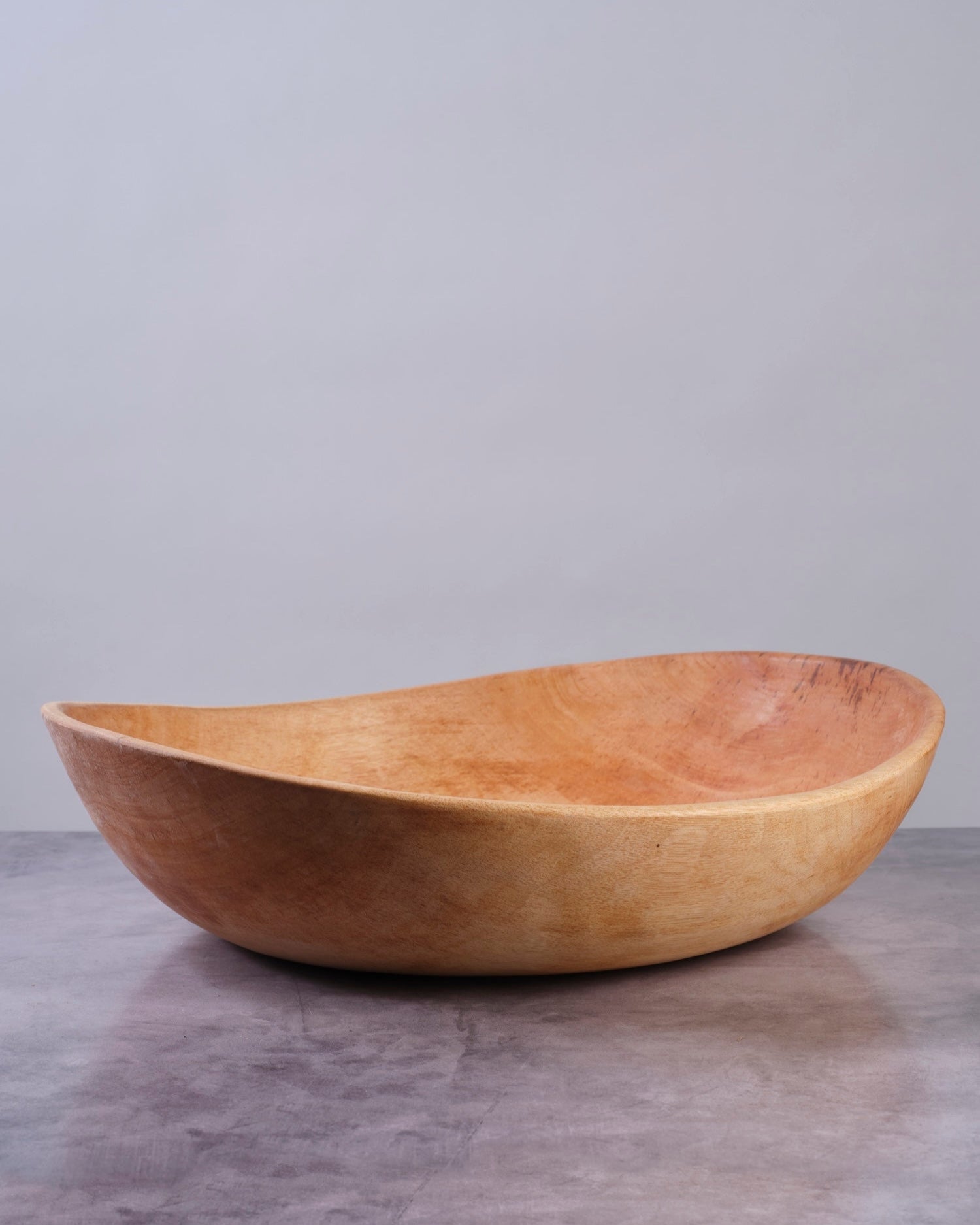
TerraKlay's bowls are carved. A single block of Higuerilla hardwood is worked by hand with chisels and adzes by Yanesha artisans in the Peruvian Amazon. No lathe, no spinning, no template.
The practical difference shows up in three places:
If you want a gift that is visibly made by a person rather than by a machine a person operated, this is the difference you are paying for. It is also, bluntly, the rarer of the two — the large-bowl category is dominated by turning.
"One of a kind" is a phrase that has been worn smooth by overuse, so here is the mechanism behind it.
A tree lays down two kinds of wood. Heartwood at the centre is older, denser and darker — the tree has filled it with resins and tannins it no longer needs for moving water. Sapwood nearer the bark is younger and paler, still doing the work of carrying water up the trunk. Where a carver's block sits inside the trunk determines how much of each ends up in the finished bowl, and at what angle.
That is why two bowls carved from the same tree on the same day come out looking like cousins rather than twins — one with a pale sweep across the rim, one nearly uniform, one with the boundary running diagonally through the base. Nobody chooses it and nobody can repeat it.
(We wrote about this at length in Heartwood, Sapwood, and Why No Two Hardwood Bowls Look Alike.)
For a wedding gift this matters more than it does for a normal purchase. The couple is not receiving a model. They are receiving a specific object that no other couple will ever have.
The bowls are carved from Higuerilla (Micrandra spruceana), a Peruvian Amazonian hardwood that grows to 30–35 metres with trunk diameters approaching a metre. That last figure is why a 24" bowl from a single block is possible at all — the tree has to be wider than the bowl.
The carving is done by Yanesha artisans in the Palcazú Valley in Pasco, Peru, working through PaTS — Partnership and Technology for Sustainability, a nonprofit whose acronym comes from the Yanesha word pats, meaning Earth. PaTS has worked with Yanesha communities for over a decade, training carvers and building a market for managed-forest timber as an economic alternative to illegal logging. The arithmetic behind that work is stark: a tree sold to a logger is worth roughly $100, and the same tree converted into artisan products is worth roughly $2,000 to the community.
We are a member of Chicago Fair Trade and follow the principles of Fair Trade.
For a wedding gift in our the 20" Classic Round is the one to send. It is the size that reads as a serious gift the moment the box is opened, it serves a dinner party of ten to twelve, and it is the piece most likely to end up on the counter permanently rather than in a cupboard.
Go to the 24" Classic Round if the couple genuinely hosts — large family holidays, a dining table that seats twelve. It is the largest bowl we carry and, as far as we can establish, among the largest hand-carved single-block wooden salad bowls in current production. Within bowls being carved by hand today, at this diameter, the field is very small.
If the couple's style is more contemporary than traditional, the "Wave" profile is the same construction with a softer, asymmetric rim — and the 17" Wave is the one an editor picked out.
At Shoppe Object New York in 2026, The Kitchn named our 17" Contemporary "Wave" bowl Best in Show, listing it among the ten kitchen gems of the show and calling it "this stunning, hand-crafted wood bowl by TerraKlay."
We mention it because third-party judgement is worth more than anything we can say about our own work. (The full story is here.)
In February 2021, Daphne Oz posted a photo of a kale salad in an enormous wooden bowl and wrote: "super BOWL!! recipe for this kale salad with apple, farro and lemon-maple vinaigrette is on my IGTV and so many of you asked about this mega wooden bowl I use all the time." A TikTok of the same bowl later passed three million views, and the comments were largely people asking the same question — where do you get one.
Her own bowl came from a home goods store in Portland, Maine that has since closed, and she has no relationship with us. But the bowl she made famous is the higuerilla style, and "Daphne Oz salad bowl" has been a live search term ever since. If you arrived here from that search, the 20" Classic Round is the piece people are looking for. (More on that here.)
A bowl this size does not need wrapping so much as staging. The pairings that work:
If you are the couple rather than the guest: every major registry platform now supports adding items from any website — Zola, The Knot and MyRegistry all do it through a browser button or by pasting the product URL. Couples add our bowls this way regularly, and guests buy them off those registries.
Hand wash, dry promptly, and oil it a few times a year with a food-safe oil. Never put it in a dishwasher and never leave it soaking. That is genuinely the whole regimen — and done properly it is the reason these bowls outlast the couples who receive them. Our full guide is here.
Common guidance in the US puts a close friend or family member in the $100–200 range, rising for very close relationships or when giving as a couple. Heirloom gifts are a deliberate exception — a single lasting object at $400–600, often given jointly by several guests, is a well-established alternative to several smaller registry items.
A 17" bowl serves four to six as a shared course, a 20" serves ten to twelve, and a 24" serves twelve to fourteen. For a couple who hosts dinner parties, 20" is the practical sweet spot; below 17" a bowl becomes a family-of-four bowl rather than an entertaining one.
A turned bowl is shaped on a lathe, which spins the wood against a fixed tool and produces a perfectly circular, symmetrical form. A carved bowl is cut by hand with chisels, which allows non-circular shapes such as ovals and squares, leaves visible tool marks, and produces slight dimensional variation between pieces. Most large wooden bowls sold in the US are turned.
Yes, when finished with a food-safe oil and maintained by hand washing and periodic re-oiling. Avoid dishwashers, prolonged soaking and extreme temperature changes, all of which cause wood to crack or warp.
Wood moves with humidity, so a bowl that is soaked, put through a dishwasher, or left next to a heat source can crack. A bowl that is hand washed, dried and oiled a few times a year will not, and will improve in color and depth over decades.
Yes. Zola, The Knot and MyRegistry all support universal registry items — you add anything from any website using their browser extension or by pasting the product page URL, and guests purchase it through the registry as normal.
Higuerilla (Micrandra spruceana), an Amazonian hardwood, hand-carved from a single block by Yanesha artisans in the Palcazú Valley, Peru.
Every TerraKlay bowl is carved by hand from a single block of Higuerilla hardwood in the Peruvian Amazon. Because no two blocks of wood are alike, no two bowls are either — the one you send will be the only one of its kind. Shop the wood bowl collection.
Comments will be approved before showing up.